My son, Aaron, creates skillful digital imagery, as a previous post spotlighted. Below is the first photography I’ve seen from him. It’s a photo he took of the outside of our basement door with a Luna moth (actias luna) perched on the window:
It’s a pleasing photo; I like the soft colors and the different textures. The weathered doorknob and the bare wood where the knob has rubbed the old door over the years add interest and contrast. It also provides a sense of scale; everyone knows how large a doorknob is.
As in my earlier post about moths, I have to provide a little bit of background info: Lunas are silkworm moths, and one of the largest moths of North America; some can have a wingspan of four inches. They only live for a week. Seems a pity. The round markings on their wings are said to resemble eyes for scaring off predators.
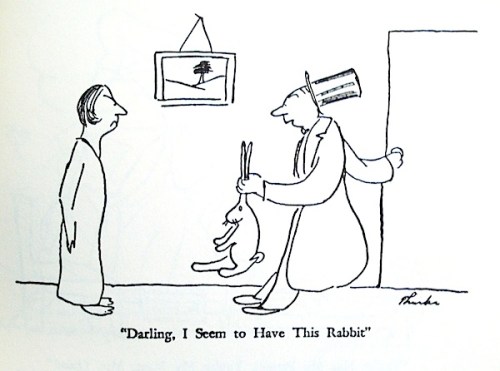
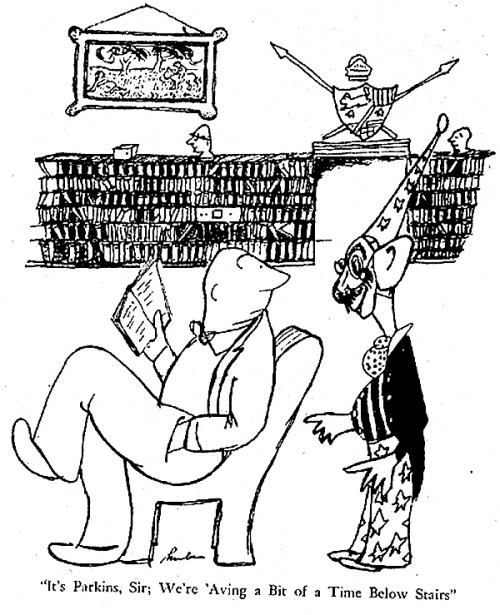
I’ve been accused of having a dry sense of humor, so maybe that’s why the cartoons and writings of James Thurber appeal to me so. The title of my blog, of course, is a reference to one of Thurber’s best books.
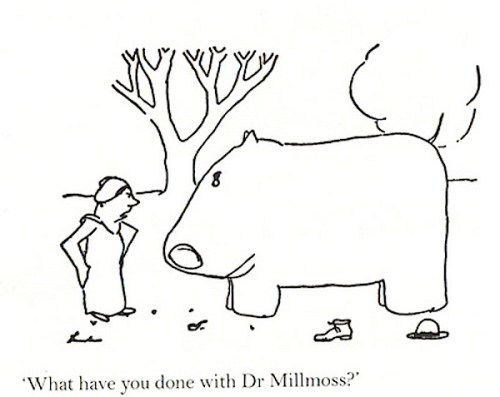
When I was in college, someone in the Dean’s office had the bright idea to make me the dorm resident adviser, or RA. Since I had skipped the first two years of college and Florida Atlantic didn’t (at that time) have freshmen or sophomore students, I was at least two years younger than anyone else around the place. Crazed with the possibilities of my assignment, I bought a can of black paint and a 1/2-inch brush and painted a ten-foot high copy of the “What Have You Done With Dr. Millmoss?” cartoon on a starkly bare buff-colored concrete-block dorm wall.
Some folks liked it but when I left the university, they charged me $150 to have the wall repainted by the college maintenance crew. Philistines!!!
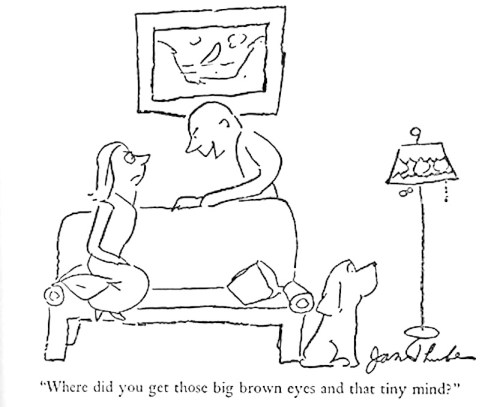
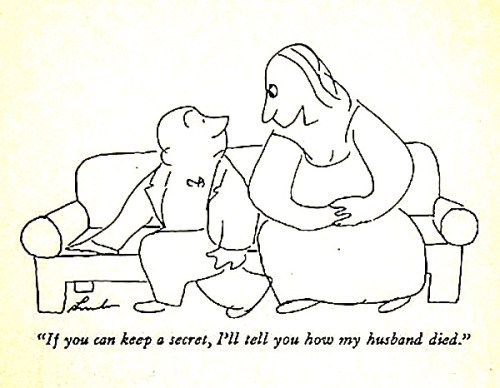
Thurber, a writer and editor for the New Yorker magazine when it was at its best in the 1930s through the 1950s, couldn’t draw worth a hoot in the conventional sense. Yet he loved to create doodles of floppy-eared dogs, timid men and dominant women and some of the editors insisted these be in the magazine. The cartoon below is unusual for Thurber, as it shows a dominant man. The expression on the woman’s face, however, indicates the man may have met his match.
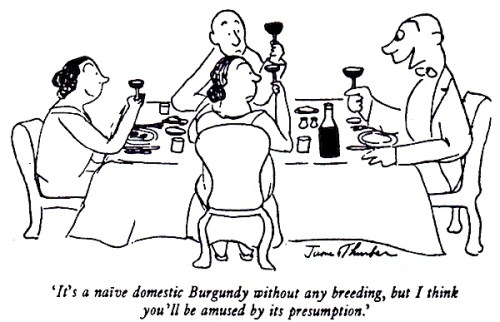
The New Yorker’s founder, Harold W. Ross, hired Thurber initially as the managing editor to make sure the magazine got out on time. He was puzzled by Thurber’s cartoons, but realized they had a quality that others could appreciate perhaps more than he could. Note the stance on the man in the cartoon below. Probably by accident, Thurber conveys that the man has had a bit too much to drink.
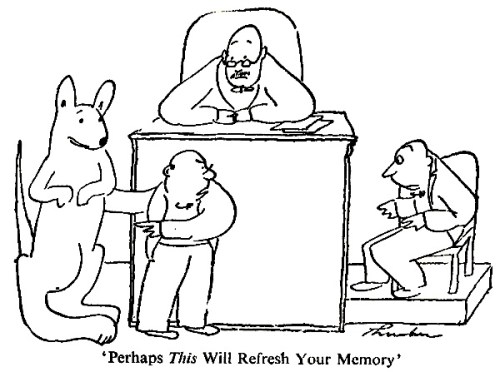
Plagued by bad eyesight, Thurber was a crotchety person at times and that sometimes comes across in his cartoons. He also felt that men and women were often at war, and wrote and drew an entire book of cartoons based on that subject. Other of his cartoons, as in the one below, document befuddlement between folks regardless of gender.
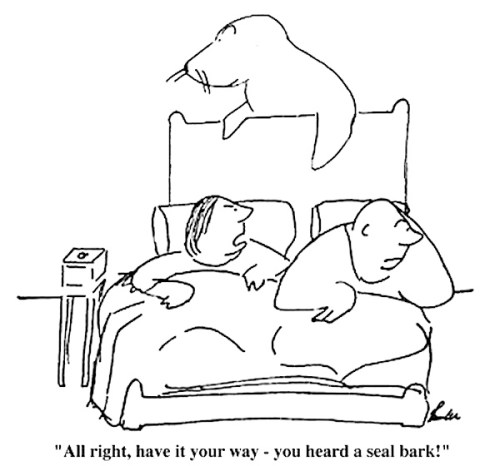
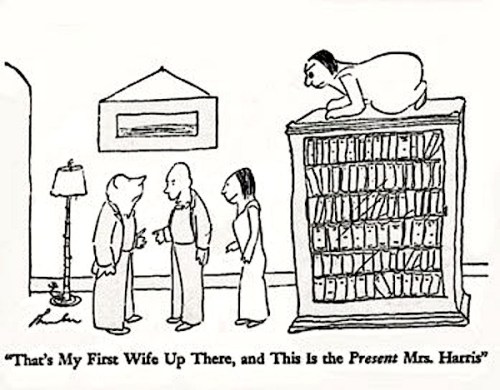
Many times his cartoons came about because he didn’t have the skill to draw what he initially intended. The classic first wife/present wife cartoon came about because he couldn’t draw the perspective of a stairway. The seal cartoon at the top of this post didn’t start out to show a seal behind the headboard of a bed but it ended up that way.
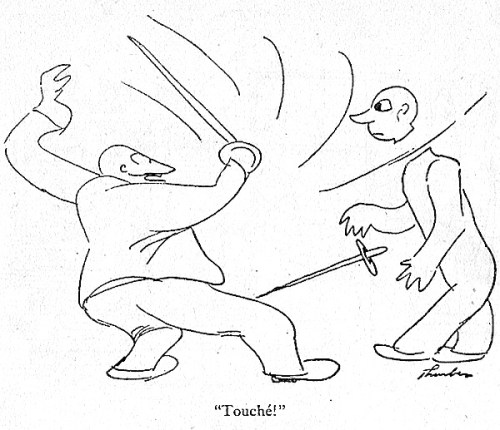
At other times, he would be assigned to draw a cartoon that wouldn’t work if a better artist drew it. The famous “Touché!” cartoon was submitted by a cartoonist who drew in a realistic style. The editors gave the cartoon to Thurber to draw, as no one would think his cartoon people had blood.
Thurber’s obvious limitations irritated some readers and even other cartoonists. A cartoonist once wrote a letter to Harold Ross asking, “Why do you reject drawings of mine, and print stuff by that fifth-rate artist Thurber?”
“Third-rate,” Ross replied.
Here are ten of my favorite Thurber cartoons. I urge you to get a Thurber book; all are excellent. Perhaps the best book for someone new to his work is A Thurber Carnival, a collection of his brilliant short stories and cartoons.
Lurching into its third month, the Ingraham Street construction in Hyattsville continues.
Having put in spanking-new sewer-feeder pipes, which required tearing up the street that had been newly paved two years ago, the WSSC’s contractors are hard at work today. They’ve replaced a lot of the concrete curbing that had been damaged in the last two months. They’re replacing driveway aprons that were messed up (including ours). They plan, by the end of the week, to have a newly paved street for us, curb to curb, as they put it.
Isn’t that nice? I think so.
What strikes me as bizarre is that the following week, the Washington Gas contractors plan to tear up a chunk of the brand-new street to replace the gas lines damaged last month; these lines serve the house next door and one across the street.
Honest to God. Tearing up a week-old street.
Hyattsville’s mayor, Marc Tartaro, who is a hard-working and intelligent person, responded to some of us in an email that the city has little control over what the public utilities do to our streets. Marc promised to try to get the utilities to coordinate their efforts to avoid having to patch a brand-new road surface, but I got the sense that he may not be able to do it.
City Communications Director Abby Sandel, Mayor Marc Tartaro. Photo: Chris Suspect.
Sometimes you just have to laugh because crying does no good. Updates to follow!
UPDATE; TUESDAY MORNING:
This is good news!
It appears to me that our mayor, Marc Tartaro, has managed to do what I frankly thought was impossible: The contractors are digging on the street this morning, which implies to me that the gas main is being repaired before the street will be totally repaved!
So, our snazzy new street might stay snazzy looking for a while.
Thanks to Marc, his staff, Washington Gas, WSSC and all the contractors! Good work!
FURTHER UPDATE:
As impossible as this is to believe, today’s giant hole in the street is being dug by the WSSC contractors exactly where the Washington Gas folks need their hole to be dug, but the gas line isn’t being replaced today. This particular hole is to repair a sewage line not the gas line.
So, I spoke too soon! The new street will be torn up according to the original schedule, one week after being totally repaved.
Bureaurocracy wins! How could I have doubted it?!?!?
I suspect so; it seems kinda goofy, too hip by half and annoying. Who really cares what you’re ordering at the coffee shop? I tried it for, I believe, three days.
Many of the folks tweeting around now may not remember how hip Citizen’s Band radios were in the United States around 1976-1978. They were hugely popular in that time before the internet and cell phones.
Perhaps spurred by the C.W. McCall song, Convoy, and certainly spurred by the Smokey and the Bandit movies, folks all over had these radios installed under their car’s dash and sent in their coupon to the U.S. government for a license to use it. Then the hipster had to learn how to talk on the thing, which was an art form. Anything had to be said in a fake Arkansas accent if at all possible.
Here’s The Bandit as played by Burt Reynolds:
Very important was your CB radio name, or “handle.” Much thought was given to this important item, much like screen names today. My handle, of course, was “Boy Howdy.”
Much of the CB radio traffic had to do with highway travel and avoiding police while speeding. Some valuable info, like traffic jams, closed roads, speed traps or other things to avoid, was sometimes provided.
I worked with a guy who couldn’t afford air conditioning for his car, when cars often didn’t come with it as standard equipment, or a CB radio. He bought a broken microphone with a coiled cord, rolled up his windows in the Florida heat and drove around hoping to look cool. Didn’t work. He’s probably a super tweeter today.
Some CB enthusiasts had high-power transmitters on their radios; I knew several people with radios so powerful that keying the mike could make a nearby fluorescent tube light up even if it wasn’t connected to a fixture!
After about 1978, all the excitement was over and CB radios were as old-school and unhip as eight-track tape players, multiple gold chains, mullet haircuts and vinyl tops on automobiles.
CB radios famously had their own lingo. Here’s a sample of what was considered cool twenty-five years before LOL, ROTFL, BRB and so on: 10-4: Affirmative. Can also be used to denote agreement (“That’s a big 10-4.”) 10-7: Out of commission 10-20 (more often simply “20”): Location, as in “My 20 is I-95 at exit 13.” Anklebiters: Children Bear: Police officer Bear in the air: Police aircraft Bear taking pictures: Police with radar Breaker: Telling other CB users that you’d like to start a transmission on a channel. May be succeeded by the channel number, indicating that anyone may acknowledge (“Breaker one-nine” refers to channel 19, the most widely used among truck drivers). Clean and green: No police or obstructions ahead Convoy: Group of three or more truckers in a row, usually exceeding the speed limit County mountie: Deputy sheriff’s car Double nickel: The 55mph speed limit Driver: Polite form of address when you do not know someone’s on-the-air nickname. (See “Handle”) Drop/put the hammer down: Pressing the accelerator pedal to full speed Feed the bear: Pay a traffic fine Handle: Nickname a CB user uses in CB transmissions. Other CB users will refer to the user by this nickname. To say “What’s your handle?” is to ask another user for their CB nickname. Negatory: No Reefer: Refrigerated trailer Smokey: Law officer, particularly state police or highway patrol
UPDATE:
A friend asked me to give some guidance to the CB radio terms in the C.W. McCall Convoy tune that I didn’t already identify, so here goes. I got most of these off Net sites; the plot of the song is that a bunch of truckers are going from California to New Jersey or maybe New York City.
C.W. McCall, by the way, was the fictitious name used by the writer and singer of that song, who was really Omaha ad agency art director, Bill Fries.
10-Roger: Cute form of 10-4
Cab-over: Style of semi-truck tractor with a flat front due to the cab being over the engine
Catch you on the flip-flop: “I’ll talk to you on my return trip (on the way back home).” Chicken coop: Weigh station Chi-town: Chicago, Illinois Copy that: Message received Got a copy?: “Do you hear me?” Flagtown: Flagstaff, Arizona Front door: The first vehicle in the line of a convoy Headin’/huntin’ for bear: Coming up on a police blockade Jimmy: a GMC truck Keep the bugs off your glass and the bears off your . . . tail: The real phrase is “keep the bugs off your glass and the bears off your ass.” A typical CB sign-off that means to drive carefully and watch out for speed traps. Longhaired friends of Jesus: Hippies Microbus: Volkswagen Microbus or van. Very popular vehicle among the hippies during the 1960s and 1970s.* Another popular song that mentions the Volkswagen Microbus is Alice’s Restaurant Massacree by Arlo Guthrie. On the side: A break in the conversation
Rigs: Semi-truck brands, like Kenworth, Peterbilt or White, or types of semi, like cab-overs or reefers Shakeytown: Los Angeles, California Suicide jockey: Driver of a hazardous material truck Swindle sheets: Truckers’ logs. Truckers have to keep logs of what they were hauling; these “swindle sheets” must be presented to Department Of Transportation officers on request. Ten-nine (10-9): Repeat message Tulsa-town: Tulsa, Oklahoma
*My VW Microbus (owned from 1969 to 1974) was a 1963 blue-and-white onewith Budweiser-label fabric curtains and quality eight-track sound pushed through a Fender Showman speaker cabinet. — Jim
FURTHER UPDATE:
This is turning into a mammoth post; there’s more interest than I anticipated!
Now some folks want to know why police, especially state police or troopers, are known as Smokeys or bears. Most of you already know this, but it’s the hat.
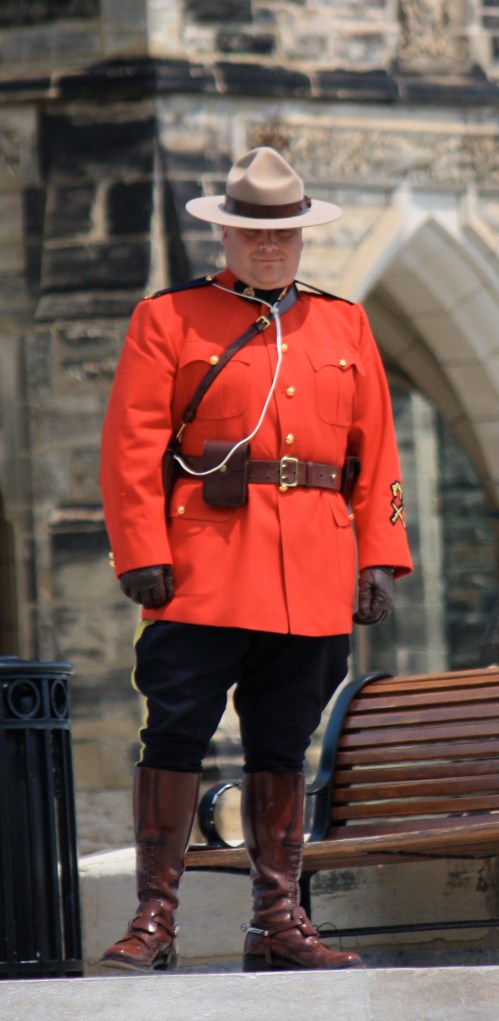
When Smokey the Bear was chosen as the cartoon mascot of the U.S. Forest Service in 1947, he was drawn wearing a campaign hat. This cool-looking hat, known in the U.S. Army as the 1911 Hat, Service, M1911, is a broad-brimmed hat, usually made of felt, with a high crown, pinched symmetrically at the four corners (the “Montana crease”). The Montana crease was developed so that rain would not collect in the creases of the hat.
These hats are still worn by Army drill instructors, forest rangers and such, but they’re most often seen on state police or highway patrol officers. In Canada, they’re worn by the Mounties.
So that’s why, in trucker’s and CB lingo, state police are called Smokeys or bears!
One of the unintended consequences of the gasoline shortages of the early 1970s was that cars with big engines could be had cheap. For those who weren’t around in those days, gas in most localities could only be purchased on the odd/even system based on your auto tag numbers, and that’s if it was available at all.
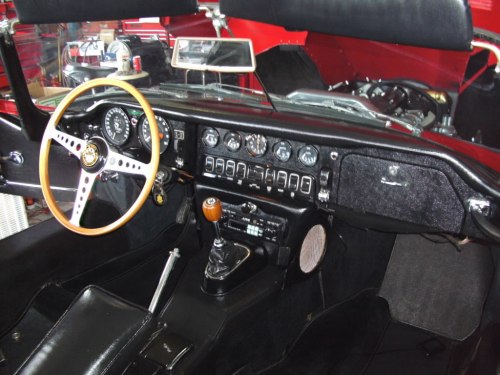
Dash looked like an airplane cockpit!
In Naples, a few of us found a way to avoid the lines and didn’t suffer too badly. But across the U.S., folks might spend an entire day in line to get five dollars worth of gas, only to be refused at the end of their tedious wait.
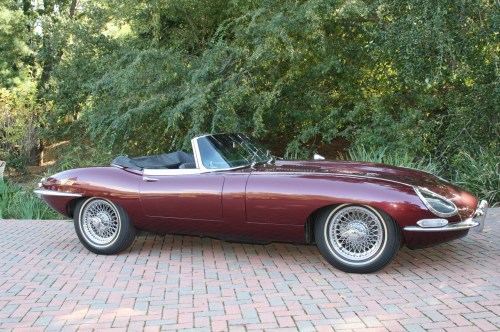
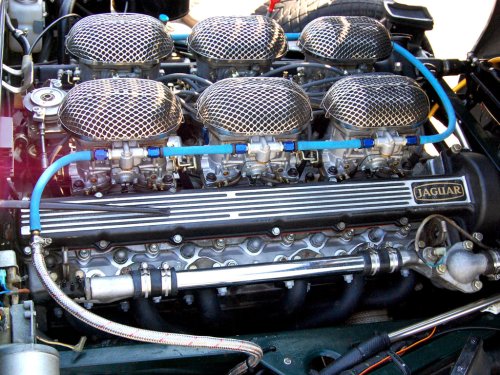
In 1974, I had moved to Tampa and had just met my future wife, Patty. A block or so north of where I worked was a used-car lot that sold high-end cars. Having saved up a few thousand dollars and ready to buy a car, I stopped there and fell in love with a 1967 burgundy Jaguar XKE convertible with the enormous gas-guzzling V-12 engine. Hey; this gas crisis can’t last forever, can it?!?!?!
What a plant!!!
I took Patty by the lot to show it to her, and she immediately balked, saying she wouldn’t be seen in such an ugly car. I was astonished; the Jag was gorgeous but so was Patty and I made the obvious choice.
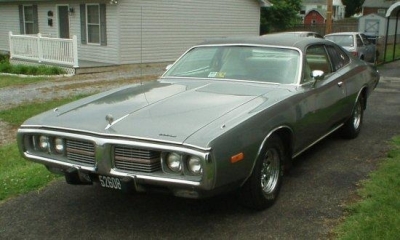
Still needing a car, I bought one of the worst ones I ever owned; a brand-new Dodge Charger Special Edition. What a lousy car that was; a real POS. It also had a huge engine (a hemi, for you motor-heads), but it ate fan belts three at a time, constantly overheated and to top it all off, wasn’t very quick. I drove that bomb for two years, buying fan belts every month (you had to replace all three if one failed) and thinking of that Jag engine that had metal chains instead of rubber belts.
Here’s exactly what my Charger looked like:
Yuch!
A couple of weeks after buying the Charger, Patty, her younger brother Billy and I were going somewhere and an XKE Jag went by us. Patty remarked, “What a beautiful car!”
WHAT?!?!?!? I slammed on the brakes so hard the Charger did a 180 on Busch Boulevard, and asked, “What did you say?!?!” She meekly replied, “I said ‘What a pretty car.’ ”
I was frosted. “Just two weeks ago you stopped me from buying one of those because you said it was so ugly!!!”
Patty burst into tears and said, “You are such a terrible driver; if you drove a car like that Jaguar you’d kill yourself in a week.”
As we sat in that horrible Dodge Charger facing the wrong way on Busch Boulevard, traffic beeping and honking as it passed us, I had to admit that Patty was correct.
Here are some amusing videos from YouTube for your weekend edification and enjoyment. The first shows a musical young man originally from Baltimore, Frank Zappa, on the Steve Allen Show in 1963. Frank plays the bicycle: http://www.youtube.com/watch?v=y9P2V0_p6vE
For those with a limited knowledge of early television, Steve Allen was a former jazz DJ who was the first star host of the Tonight Show. He was a respected musical composer and also guest starred in the Superman newspaper strip as a lookalike for Clark Kent.
Frank seems somewhat shy yet articulate in this amusing sketch. Zappa was later busted in a police sting for making an allegedly pornographic audio tape; he spent several months in jail but had a successful career after that ordeal as the leader of the Mothers of Invention and other brilliant music endeavors.
Next, a 14-year-old Jimmy Page in 1957 plays skiffle on a British television show; the Hofner archtop guitar he plays seems as big as he is: http://www.youtube.com/watch?v=NfZ1AEdfd1o
Jimmy is the young man in the dark sweater and white shirt. He went on to play guitar in British music producer Mickie Most’s studio band, backing singles by Herman’s Hermits, Donovan and Brenda Lee. After that, he was in the Yardbirds and, of course, Led Zeppelin.
Onward we go, still in the late 1950s. We meet a pair of young singers working for various low-budget record labels in the New York City area. They recorded a lot of covers and a few of their own songs. Known professionally as Tom and Jerry, they struggled for years before splitting up. The guitar player and songwriter of the duo, Paul Simon, went to England by himself to try his luck. Art Garfunkel, the lead vocalist, stayed in the NYC area and concentrated on his college math studies.
A record producer, Tom Wilson, liked a cut on their very obscure 1964 album, Wednesday Morning 3am, and on his own volition, had electric guitar, bass and drums added to Paul’s simple background guitar on the tune. He released this version in 1965 without the knowledge or approval of Paul or Artie and it became very popular. Columbia Records quickly got the duo back together to capitalize on the unexpected popularity of the song, Sounds of Silence, and Simon and Garfunkel became a best-selling musical team.
In the 1960s, there were a number of great superhero or adventure comic books featuring groups. There was the Justice League of America, the Fantastic Four, The X-Men, The Avengers, The Legion of Superheroes, The Doom Patrol, The Teen Titans, Sgt. Fury and His Howling Commandos, The Mighty Crusaders and others. I enjoyed all of them, but my favorite was Blackhawk.
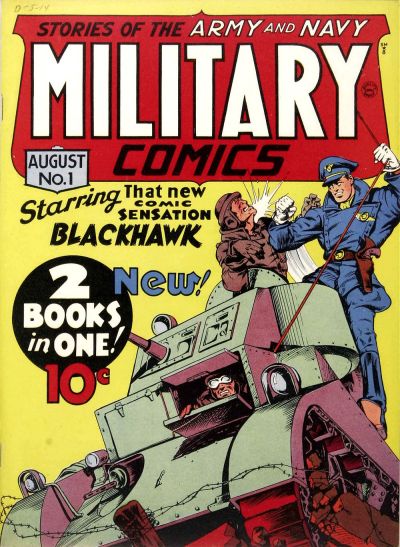
The Blackhawks first appeared as the lead feature in Military Comics in the the summer of 1941, before the attack on Pearl Harbor started World War II. They soon had their own comic book. The legendary Will Eisner had a hand in their beginnings; he was either editor or creator, depending on who tells the story. “Hawkaaaa” was their battle cry and they usually ended an adventure flying off the bottom panel of the comic-book page while singing a victory song.
If you want to learn much more about the origin of the Blackhawks, here’s a blog by a fellow Maryland WordPress blogger that is well worth your attention:
Here are the first Military Comics and Blackhawk covers; the first Blackhawk comic was #9 because Quality Comics used their U.S. Postal permit from their cancelled Uncle Sam Quarterly:
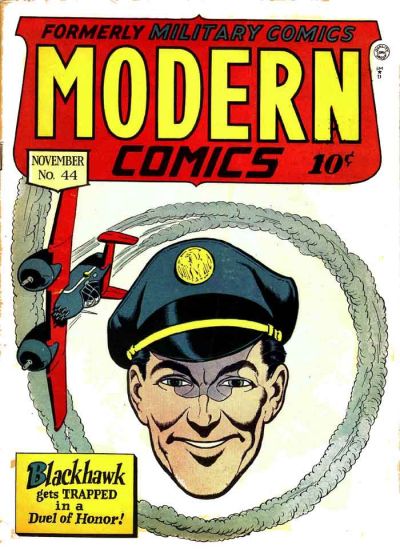
After WWII ended, Military Comics changed its name to Modern Comics. Here’s the first cover with the new name:
All these were issued by the Quality Comics company and the artwork was just wonderful. It was realistic, gritty and the Blackhawks had great uniforms and equipment. The airplanes alone were enough to draw one’s interest, though the stories were compelling; full of nasty men and women who were all defeated by the Blackhawks. The women were unfailingly attractive; and nearly all of them fell in love with Blackhawk, who was the Polish-born leader of the seven-man team.
Please know that the Quality-era Blackhawks weren’t politically correct if viewed with a 21st-century mindset; one of my buddies on a Lincoln history forum has a great quote worth remembering:
The Past is a foreign country . . . they do things differently there”
— L. P. Hartley
In the panel above, the earnest young lady’s dad, who was making earthquakes and avalanches in South America for the benefit of the commie empire, is going to prison for life, but all she can think of is how cool Blackhawk is! Hawkaaaaaaaaaaa!!!
In 1956, Quality Comics sold the rights to their characters to DC Comics, and DC continued Blackhawk. Here’s the first DC issue:
Note that the comic-book title is singular but the team name is plural. The DC Blackhawk had the same artists and some of the same writers, but instead of fighting Nazis and commies, the Blackhawks were often fighting super villains and monsters. No matter; they were still a great read.
After a couple of years, DC decided to fiddle with the formula and the Blackhawks were clothed in what one commentator has described as uniforms better suiting valet parking attendants:
The stories and art were still okay, but a couple of years later, during a strange comic-book interlude that began with the campy Batman TV show and the James Bond/Man from U.N.C.L.E. fads, the Blackhawks were turned into an embarrassingly inept group of semi-superheroes, with silly names and even sillier costumes. It didn’t last long and to make things worse, some of the big-time DC comics heroes introduced this horrible concept on the front cover!!!
I refuse to show you the new uniforms the Blackhawks wore during this period. They are painful to behold.
After several terrible issues, the decision was made by the DC honchos to cancel the title. At the same time, a talented artist and editor, Dick Giordano, came to DC from the Charlton Comics company. He loved the original Blackhawks and when he took over the comic, he tried for two issues to bring back the original concept, including the black leather uniforms. It was too little too late. Blackhawk was cancelled in 1968.
DC has had a few revivals of Blackhawk since then but they never seemed to catch on, for whatever reason.
So why am I telling you all this?
Because for several years I have had an idea for a great Blackhawks revival! It would be composed of a group of young black men and women, and I think the concept would be interesting and fun. I’ve given this a lot of thought and may well put it all down on paper one day and send it off to DC Comics.
That’s how happy I’ll be when I taste Patty’s apple pie later tonight. Of course, I’m no angel, but who is?
I’d be happy to give you the recipe but Patty got it on the Net and didn’t divulge it to me; I saw her iPad propped on the toaster when she was chopping the apples. The apples were Maryland honeycrisps, if that helps. Patty thinks they’re probably too sweet for a pie, but I bet I’ll like ’em.
I had never heard of a honeycrisp apple, but a website tells me that they were developed in the 1960s by the University of Minnesota and went on the market in the 1990s. They wanted to develop an apple that could withstand harsh winters.
Developing new varieties of apples is a pretty interesting subject but I’ll restrict my research to tasting them in pies. I know I can do that well!
Now, get busy on the Net, find yourself a great pie recipe and then YOU can be as happy as an angel full of pie!!!
At the end of the last Beatles public performance, held on the roof of their Apple Corps building on January 30, 1969, John Lennon remarked, “I’d like to thank you on behalf of the group and ourselves and I hope we passed the audition . . .”
Seven years earlier, they didn’t. On January 1, 1962, The Beatles, consisting at that time of John Lennon, Paul McCartney, George Harrison and Pete Best, auditioned for the Decca Record label in London; the Decca producer was Tony Meehan.
Decca Records rejected The Beatles, saying that “guitar groups are on the way out” and “the Beatles have no future in show business.” Of course, this verdict, delivered by an expert in a suit (no one at Decca Records would ever admit who it was) is the single most egregious mistake in the history of show business.
In the last few days, news outlets have been breathlessly reporting that the original Decca audition tape has been found after 50 years and will soon be sold at auction. What the articles usually fail to say is that Beatles manager Brian Epstein had several copies of that original tape made and that the audition has been available to Beatles fans for many years in very good-quality audio bootlegs.
One factor that might have lead to their rejection was the selection of songs that Epstein insisted they play at the audition. Epstein’s thinking was to show the range of material that The Fabs could handle, and he wanted to move them away from the rough-edged, leather-clad image they had developed on their own.
He put them in nice suits and chose their songs for them on this important day. There were a few original Beatles songs mixed in with Broadway show tunes, a Buddy Holly cover, a couple of Coasters covers and some romantic ballads. There were no rough edges.
The order of the songs at the session was:
Like Dreamers Do (Lennon–McCartney)
Money (That’s What I Want) (Gordy/Bradford)
Till There Was You (Meredith Wilson)
The Sheik of Araby (Smith/Wheeler/Snyder)
To Know Her Is to Love Her (Phil Spector)
Take Good Care of My Baby (King/Goffin)
Memphis, Tennessee (Chuck Berry)
Sure to Fall (In Love with You) (Cantrell/Claunch/Perkins)
Epstein continued shopping this audition tape around and on June 4, 1962, The Beatles were signed by EMI-Parlophone comedy-record producer, George Martin, who could see the group’s potential. Ringo Starr (Richard Starkey) replaced Pete Best on drums in August of ’62.
Decca Records, stung by the ridicule they received after The Beatles became the most successful music group in world history, signed The Rolling Stones on the advice of George Harrison. And John Lennon told Brian Epstein to keep away from the musical side of The Beatles.
Growing up in the ’50s and ’60s, kids were suddenly the buyers of popular music. AM radio (which at that time was really the only kind on the airwaves) was playing lots of music aimed at kids and young adults and wherever there’s a buck to be made, some sharp promoter will come up with a way to exploit the situation. Nothing illegal, but these experiences were how kids learned to read the small print and be less trusting of grownups.
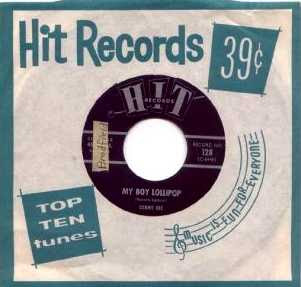
In the third grade, my allowance was 25¢ a week, and I did my best to get the most value for my two dimes and a nickel. Once, on a grocery trip with my mom, I saw a standalone cardboard bin that sold hit records at a great price: 39¢!!! What a deal!!! At that time, a legitimate 45rpm single by Elvis or Chuck Berry might cost 79¢ or more.
So I saved my pennies and I saved my dimes and the next time I went to the store with mom, I bought the record.
Yeesh. I hadn’t counted on the hit song being performed by a studio band that wasn’t even close to what I was used to hearing: Wake Up, Little Susie/Silhouettes by two unknown Tops Records bands, 1958:
That first track didn’t sound quite like The Everly Brothers and as for the second, it wasn’t even close to the version by The Rays or The Diamonds. What a burner for me, huh?
Nowadays, though, it’s kind of fun to search out some of these tacky cover versions. They range from lackluster to lame to absolutely rank. But the purpose was to get the pennies out of a kid’s pocket and into the cash register and I suppose that was one way to make a living playing music. The musicians and vocalists seldom got credit on the records, but they probably preferred it that way!
Here a Jailhouse Rock cover by Jimmy Helms from 1957 from one of those cheapo records; he doesn’t manage to get his phrasing of the lyrics in alignment with Elvis’, so he just drops lyrics here and there:
When The Beatles came out, there were a slough of fake Beatle records out there. Woe to the kid who, like me, lived in a small town and asked his mom to pick up a Beatles record when she was going to the big city for the day. That unfortunate kid might be surprised by something like this:
I Want To Hold Your Hand by The Doodles, 1964:
Or even this:
I Want to Hold your Hand, by The Buggs, 1964:
It happened to me more than once, and I learned not to ask my mom to purchase records for me anymore.













 Jim's World and Welcome To It