Home

G.E. Smith And His Telecaster Lead Me Astray . . .

Leave a comment

G.E. Smith Telecaster

I never paid much attention to G.E. Smith until early this year. He was the leader of the Saturday Night Live band and he was in some concert videos I had, but I hadn’t focused on him.

My loss!

I was starting to research the history of Leo Fender and came across this YouTube video (link above) where Mr. Smith talks about his signature Fender Telecaster. It’s a twenty-minute video, but Mr. Smith is smart, articulate and he knows what he’s talking about. He’s also pretty musical! He really has command of his instrument, as you’ll see if you watch the video. So watch it!

I’d never owned a Tele before, but this video got me wanting one. Since I have way too many guitars and basses already, I decided to use my way-too-ample spare time to research the various iterations of the Telecaster since 1950 or so; they started as the Esquire, then Broadcaster, then no official name for a while (now called No-Casters) and finally Telecaster. TV was just becoming available then and that name was a natural.

The Telecaster I put together, after countless hours of research and comparisons, is now my pride and joy. It has the big boat-hull-shaped solid-maple 7-1/4″ radius neck of the original Teles and, unlike most modern instruments, has a nitrocellulose-lacquer finish on the neck and body. The body is ash wood, so the guitar weighs a ton but is resonant with amazing sustain. I decided on gold-plated hardware simply because I had never had that on a guitar before. After researching a component of the Tele, I’d order exactly what I decided on from wherever in the world I could find it. Took me a few months to get it all together.

I like it:

I keep fiddling with this Tele I built (people call these “parts-casters”) and I just tonight ordered, with the help and advice of two talented and knowledgeable buddies (thanks, Slim and Don!) new pickups for it. It’s the guitar I love to play the most and it demands more of me than my other guitars do. Yet, it makes me a better player.

Go figure! Thanks, G.E. Smith, for your enthusiasm and knowledge.

We’re Having a Party . . .

4 Comments

Got the FJ Cruiser all packed up with gear. In addition to the stuff shown, which is my rock/rockabilly/Bakersfield country rig, there’s my ’51 Reissue Fender Precision bass, D-41 Martin acoustic, spare amp (Fender silverface Vibro Champ), my trusty Shure SM-58 mike and stand, essential cables and other little goodies.

Dave Martin is having his 23rd Annual Adelphi Music and Arts Festival this afternoon and evening, and the weather is certainly cooperating. Live music will be going on from about 3pm till midnight and there’ll be a wide variety of music; from authentic Islands reggae to Flamenco to classical to rockabilly and Appalachian folk tunes.

We always look forward to this event and have a lot of fun. Yee-hah!!!

Gazebo Nights and Knights

1 Comment

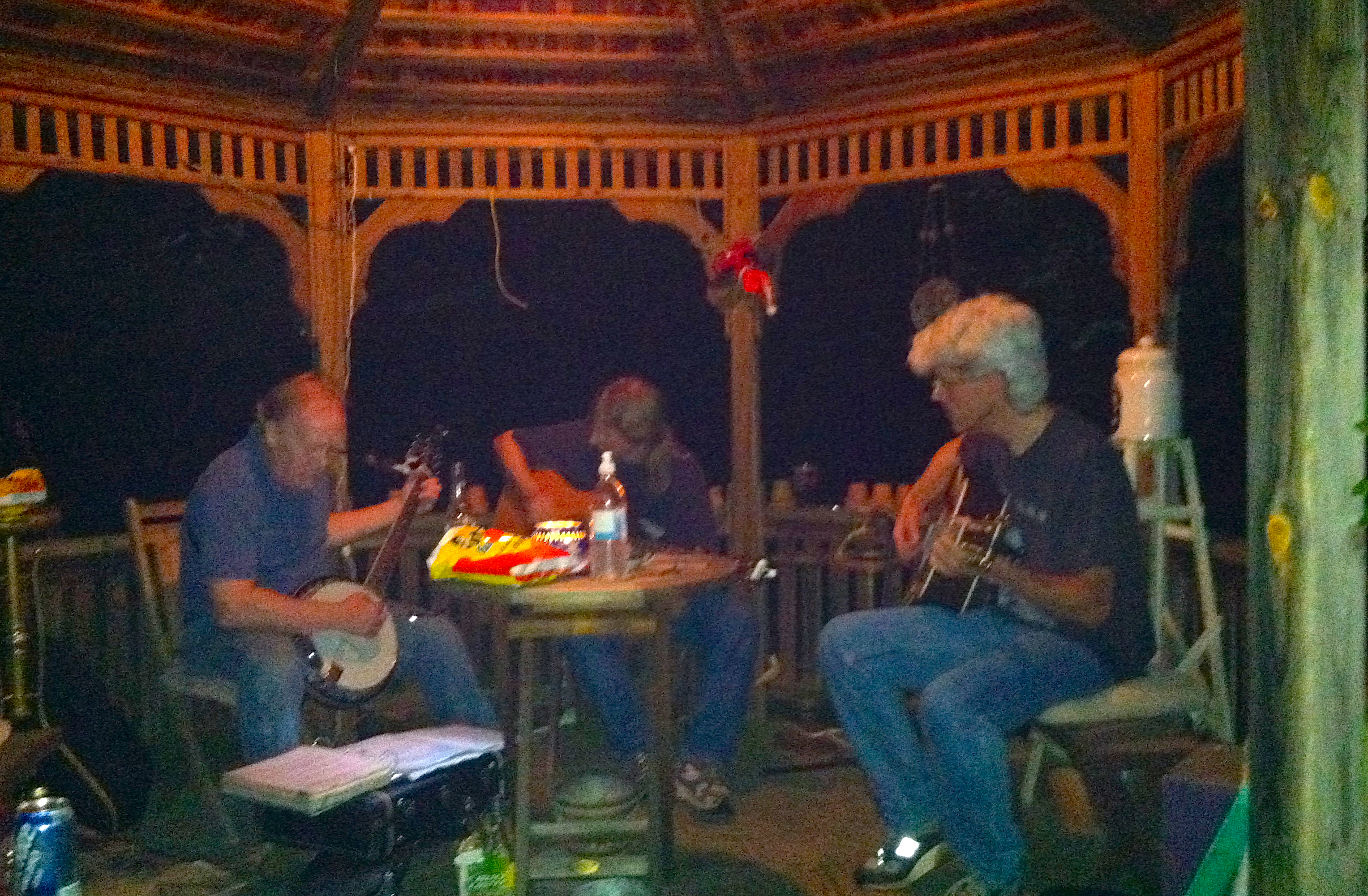
Last night, four of us gathered, as we often do, under the gazebo roof at John Sapper’s place. We’re preparing an acoustic-music set for the 23rd Annual Adelphi Music and Arts Fest that Dave Martin puts on at his place.

The weather was pleasant, the insects weren’t too intrusive, and the grove of trees behind John’s gazebo made for a relaxing atmosphere.

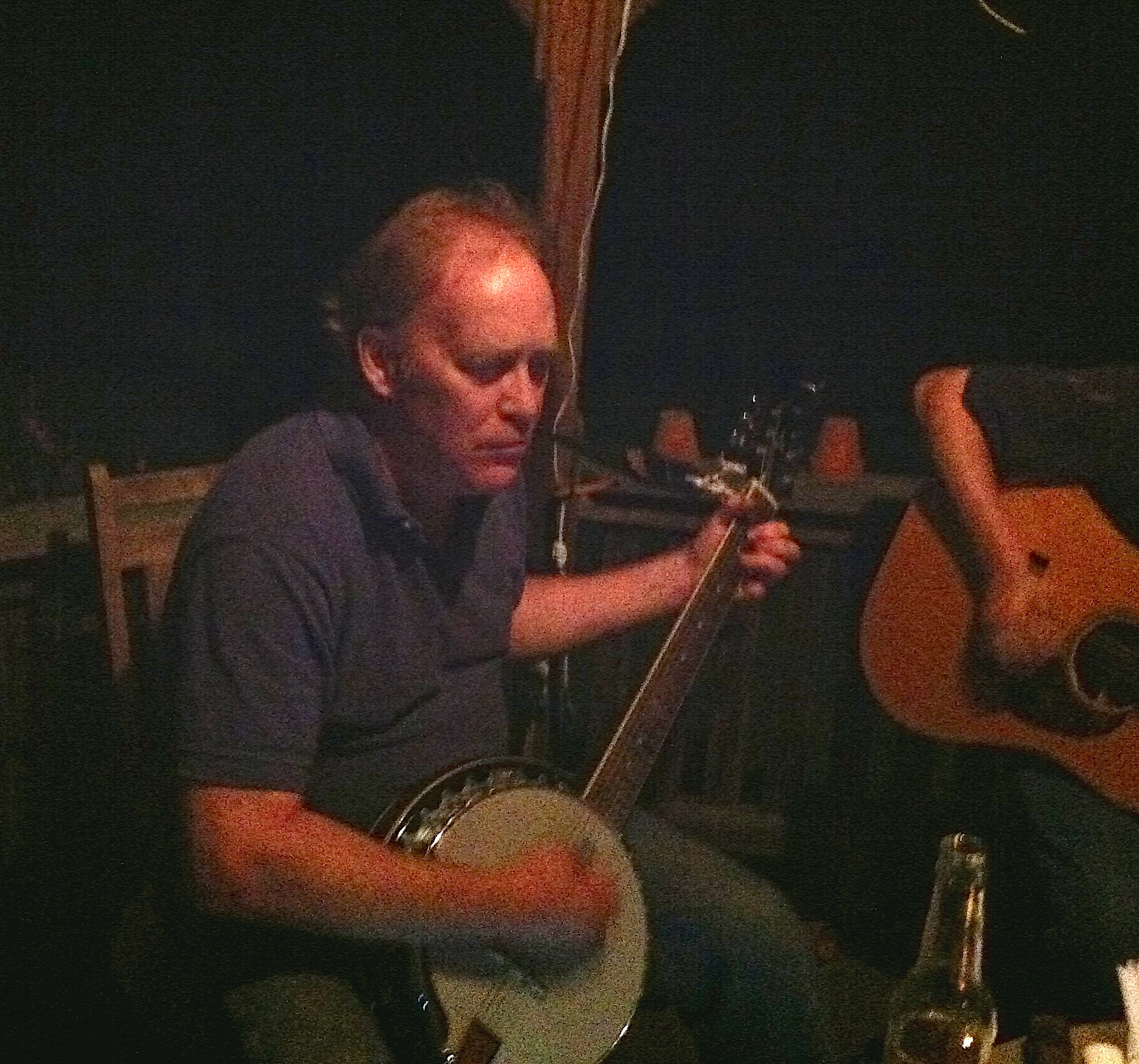
Here’s Dave Martin on his six-string banjo. Dave and I squabble like brothers; maybe because we’re as tight as brothers. We’ve been playing music and having adventures for a good number of years. As many of you know, Dave jokingly refers to himself as NFD (nine-fingered Dave) after a tragic woodshop accident in 2006. All of us were stunned when Dave was hurt, but none of us were surprised when he refused to let such a blow hold him down or keep him from playing music. If anything, his playing is better now than before the accident. Says a lot about the man:

Here’s John Sapper, our host for the evening. John is an absolute guitar wizard at tasty, perfectly articulated solos and has a deep repertoire of what he calls “fiddle tunes.” He augments these with elegant arrangements of classic and classy country and folk songs. His versions of Grandpa Jones’ Eight More Miles to Louisville and Are You From Dixie? are so good that I always insist on hearing them each time we get together, along with his flawless rendition of Machine-Gun Kelly. What a player and singer, and a genuinely nice guy. John’s playing his Santa Cruz here, for you guitar buffs out there, and he has a gorgeous old Gallagher guitar (think Doc Watson) I’ve been trying to sneak out of his house for years:

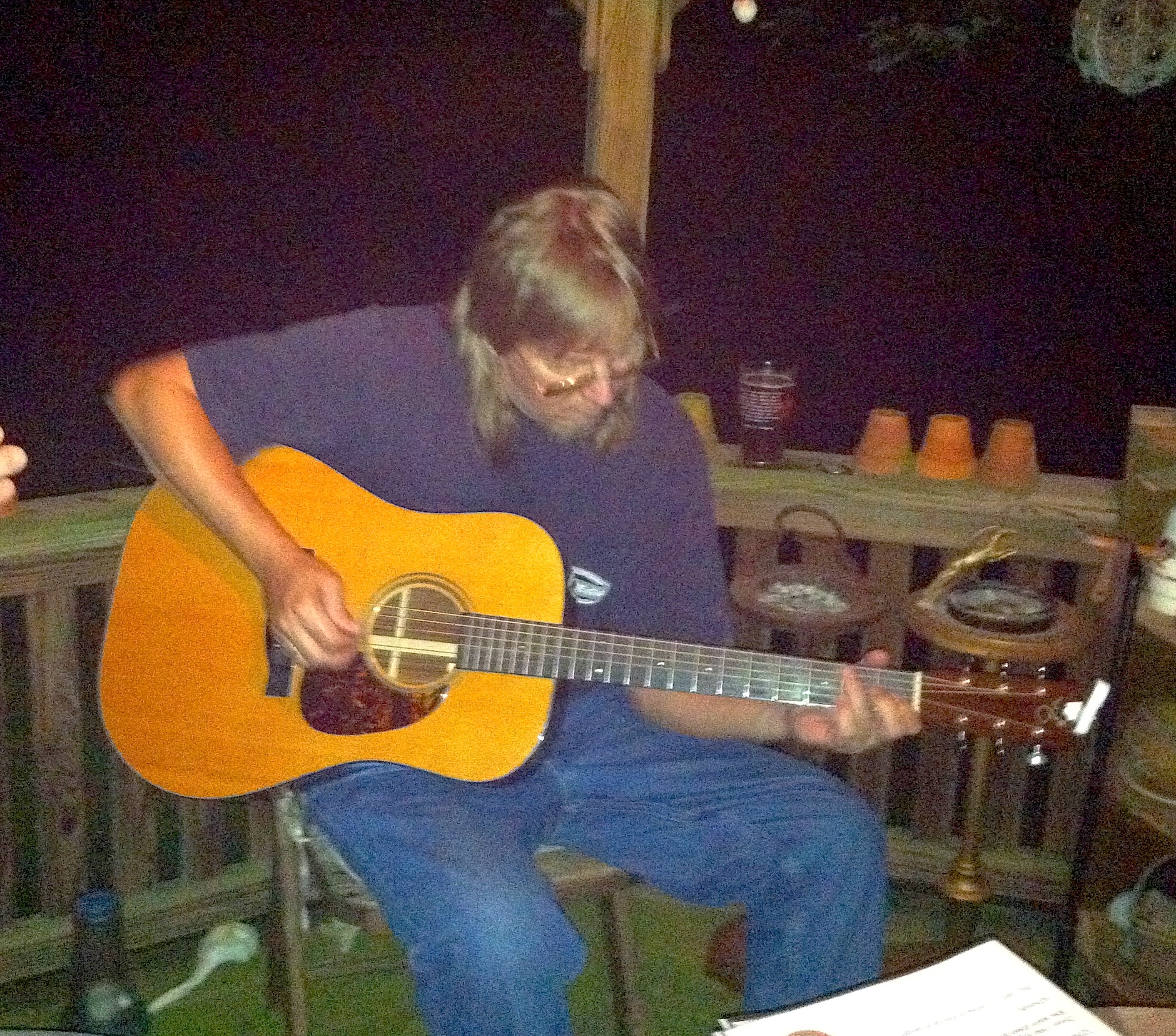
The most recent addition to our group is Doug Percival, seen here playing my cowboyed-up old Martin D-41, because we made him play some more after he had packed up for the evening. Doug’s singing and guitar playing are first rate, but we like him anyway. Doug has a knack for taking tunes you’ve heard a million times (or not) and reshaping them with novel arrangements and interpretations. He is also the only fellow I’ve met who, in a former band years ago, was flown by the U.S. military to Guantanamo Bay, Cuba, to play for a couple of weeks in the Naval Base service clubs there:

I think we’ll have a lot of fun next Saturday at Dave’s party and make some great music, too!

When Will Their Bubble Burst? Beatles For Sale!

Leave a comment

Folks who weren’t around in the Sixties may find it hard to believe, but The Men In Suits at Capitol Records refused, initially, to release Beatle records in the United States because no pop group from England had ever sold in this country. What made this even more nonsensical was that The Beatles’ UK record label, Parlophone, and the U.S. label, Capitol, were both divisions of the EMI recording giant. Thus, Parlophone was contractually obligated to offer their releases to Capitol first, and Capitol responded, more than once, “No, thanks!” Parlophone would then sell or lease the records to whomever they could find in the U.S. to deal with.

In an earlier post, I mentioned The Beatles’ Ed Sullivan Show appearance in early February, 1964. Both before and after that milestone, members of the press were constantly speculating about how long the Beatles “bubble” would last, and they’d query the band as to what they planned to do for a living once the bubble burst. Ringo famously replied to one such question that he’d like to own a beauty parlor!

So at first, if you wanted to listen to a Beatles record in this country, you had to look hard to find it. I remember the first 45 or single (two-songs, front and back for today’s younger readers) of The Beatles that I bought was She Loves You issued by Swan Records, a small independent label out of Philly.

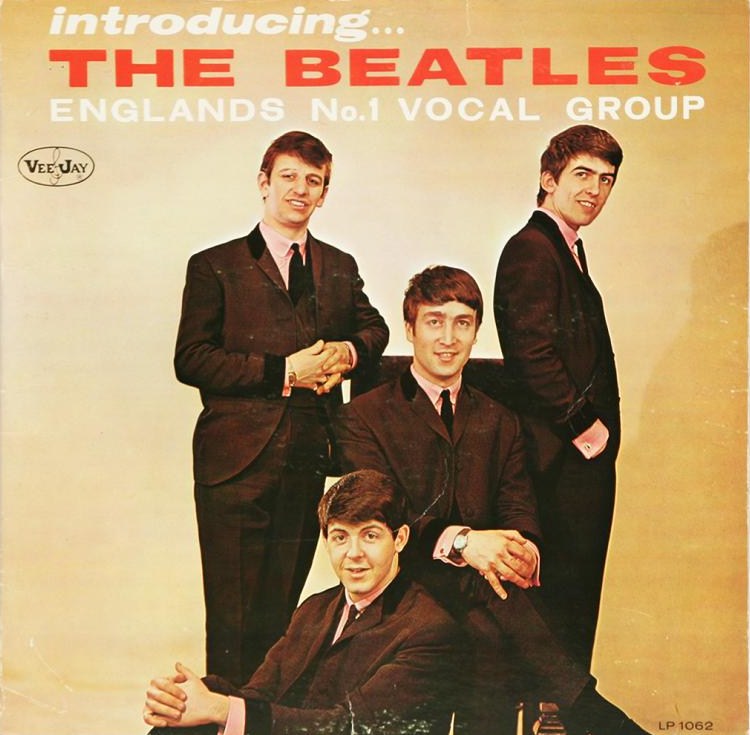
As far as albums, or LPs (long-players) as we called them then, the first release of The Beatles in the U.S. was on the jazz/R&B VeeJay label. It was a version of The Fabs’ first British LP, Please Please Me. Here’s the VeeJay album cover with some very young-looking Beatles; note that Ringo’s hair hadn’t quite settled into the “moptop” style at the time this photo was taken:

After the appearance on Ed Sullivan, Capitol released Meet the Beatles in this country, and it was a chopped-up version of the second UK Beatles release, With the Beatles:

So began a long series of U.S. Capitol record releases that took Beatles UK releases and switched or cut songs, added reverb and generally fiddled around with them.

It wasn’t until Sgt. Pepper that a Beatles LP was the same in both Britain and the U.S., and even after that, there was still some monkeying around with U.S. releases on Capitol Records.

Ladies And Gentlemen . . . The Beatles! And A Theory!

6 Comments

When The Beatles appeared on the Ed Sullivan Show on Sunday night, February 9, 1964, it was a very big deal, at least to the kids in this country. Our family was living in Fernandina Beach, Florida, and for once, I put my foot down and told my mom we had to have a new TV. Our old one had conked out a couple of months before, and I wanted to see and hear The Beatles on TV.


At that point, I was on the fence about whether I liked them or not, but I wasn’t going to miss out on the chance to see them and make up my mind. Amazingly, my mom caved in and bought us a new GE 19″ portable, and, of course, it was a black-and-white set, with the nifty stand as shown in this ad. Television wasn’t usually in color in those days; the first primetime TV season broadcast totally in color wasn’t until 1966.

This was arguably the most important television session The Fabs ever did; it was their first chance to perform in the United States and Ed Sullivan was the (then) most popular show on TV.

Now here is something I think is pretty obvious, but I’ve never seen it written about or discussed elsewhere: I firmly believe John’s mike went out on him during the last song (I Wanna Hold Your Hand). The key to this: Watch George! I can hear the audio change about 11:22 in this clip and after that point, all I hear in the vocal mix is Paul. I also think you can see at about 11:55 George is starting to realize something is amiss. If you don’t want to watch the whole clip, just move the slider at the bottom of the view to the time markers I indicate!

Listen carefully to the vocals beginning at 11:58; that should be a two-part harmony but all you can hear is Paul’s part.

I contend that George realizes at about 12:00 that John’s singing into a dead mike and starts laughing at about 12:05.

No matter; they sounded great and by the end of that show, The Beatles had done what they had set out to do: Become the first British rock-and-roll band to be taken seriously by U.S. kids. As for me, I was convinced The Beatles were something new, different and exciting, and thus began my quest to switch from playing an alto saxophone to an electric guitar.

That theater, on Broadway between West 53rd and West 54th in Manhattan, has a wonderful history. Opened in 1927 as Hammerstein’s Theater, it was converted in 1950 to use for television and was renamed CBS-TV Studio 50. Now it’s called the Ed Sullivan Theater and it’s home to David Letterman’s Late Show.

Boy Howdy!

Leave a comment

That’s an expression I’ve always used; seems to me I first heard it said as a kid in Texas.

Much later, in Naples, Florida, some of my friends and I culminated our series of bands with a lineup of John Klingler and Don Spicer on guitars, Mike Collins on drums, and yours truly on bass. We all contributed vocals and other folks came and went as time went on. We called the band Boy Howdy and we played rock, blues, Dylan, Cream, Allman Brothers and Mountain covers and whatever else we could handle.

We played the Naples Teen Center and some parties, but our regular gig was at Al Bolton’s Aquarium Bar on the Trail in East Naples, so named because he had a couple of large built-in freshwater aquariums with a giant Oscar fish in each.

The clientele was an uneasy combination of migrant workers, kids and bikers. Sometimes fights broke out and the bouncer, a gentle giant named Pabst, would settle things by falling on the miscreants like a felled oak tree. The bar was in an old Quonset hut but the acoustics were good. We played a couple of nights a week.

The Boy Howdy Band, or part of it, is shown in this photo recently sent to me by my still-best friend, John Klingler. He’s the one on the left in this photo, the drummer is Mike Collins, and I’m on the right on bass, with a cigarette hanging out of my mouth! John’s sister, Jean, found the photo somewhere.

 Taken on the evening of June 9, 1973 as we celebrated John’s 21st birthday; notice the Boy Howdy drumhead and period posters!!!

That’s why the Robert Crumb-created Boy Howdy figure is at the top of this blog. We saw that drawing as the mascot for Creem magazine and decided we’d use it, too.

John remembers some Aquarium bar madness:

Patrons of Al’s might recall an air hockey table very near the stage with a black light over it. The puck would glow, which was quite disconcerting in its own right. I shudder to think of the number of times that puck would fly off the table and hit me while we were playing. And I was on the opposite side of the stage. BTW, not present in the photo was the other guitar player in the group, Don Spicer.”

Leo the Hedgehog

3 Comments

The ancient Greek poet Archilochus wrote that “The fox knows many things, but the hedgehog knows one big thing.”

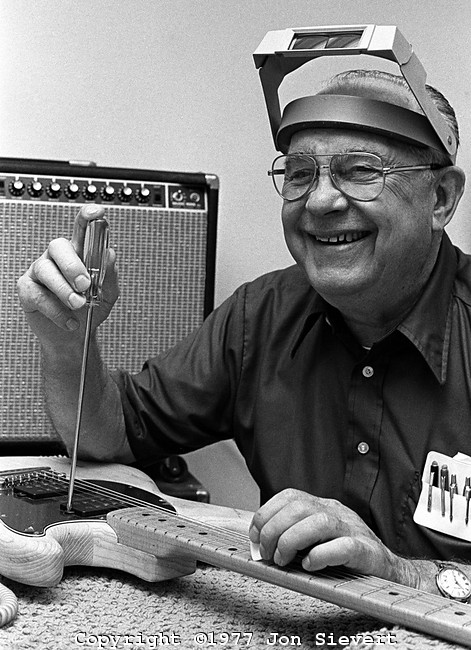
I’ve spent the last few months learning everything I could about Leo Fender, creator of Fender Musical Instruments, and I’ve come to the conclusion that, like the hedgehog, Leo had one guiding principle; his was: Make simple products for the working musician which can be quickly repaired.
Leo-Fender

Leo Fender tinkering. Photo by Jon Sievert.

Mr. Fender never bothered with a “mission statement,” which many firms try to have. Mission statements require precision of thought and clarity of vision, which is uncommon, so most mission statements confuse by including too much. Clarity requires exclusion.

How did Leo Fender develop his vision? Because he got his start as a radio repairman. Folks came to his little shop in Fullerton, California, every day with a broken thing and they needed it fixed in hours, not days, because they made their living with it. And Mr. Fender became known as someone who could fix things quickly. As he was fixing amps and PAs made by others, he noticed what was wrong with the designs of the products.

He got into making guitars– lap steels at first– so he could sell his amps. He decided guitars were too complicated and decided to simplify their construction to what was absolutely essential and could be quickly replaced without special skills or tools.

Guitars of that time– we’re talking late 1940s here– were not always made by painstaking individual craftsmen, but they did take skill and time to make. If something went out of whack, as always happens even to the best guitars, it took a lot of skill and time to correct.

Leo’s guitars were a military-grade assembly of easily replaceable components. Other guitar makers scoffed at his “canoe paddle” solid-body instruments, but they didn’t laugh for long. And the amps Leo made, from tried-and-true circuits using the best hardware he could find– war surplus was cheap and plentiful after WWII– were solid, dependable and sounded great. No one laughed at those; they were too busy trying unsuccessfully to copy them. Without Leo’s vision, other guitar and amp makers most often tripped over their own feet. It might look like a Fender product but it didn’t play or sound like one.

As long as Leo ran his company, his vision, like gravity, was always in effect. Leo wasn’t a socializer and he was thrifty to a fault. He was happiest tinkering with new ways to simplify and improve things and he’d only pal around with those who produced something with their hands.

Leo didn’t design his products for rock and roll, because that wasn’t being played in the clubs and honky-tonks of his day. He and his assistants would take their prototype guitars and amps to local clubs where country guitarists worked, and have them try them on stage. Leo listened to the comments and criticisms he got from these working musicians and incorporated their feedback into the next prototype.

When kids who grew up hearing country, gospel, blues, folk, rhythm and blues and other music got the early Fender products in their hands, it sparked a revolution in music. The hedgehog Leo, who never played guitar, wore hearing aids and hadn’t planned to help create rock and roll, was astonished. Happily astonished. And so were we.

In this photo from 1950, Leo Fender is on the right. The player holding the Fender Broadcaster guitar is Dub Williams and the fellow behind him is singer/songwriter/bandleader Eddie Miller; together they wrote the classic “Release Me.” The woman hasn’t been identified.

Fender After Leo:

Leo sold Fender Musical Instruments to CBS, the TV folks, for a staggering amount of money in January of 1965, because he thought he was dying. He wasn’t, and CBS, full of foxes and savvy operators, ran Fender into the ground. Even teens like me realized the CBS-made Fender guitars and amps were less than what they had been, and a market grew for “pre-CBS” Fender products.

Some brilliant Japanese craftsmen made a huge impact in the mid-1970s building guitars like Leo made them. They’d buy old Leo-made Fenders, blueprint them down to the tiniest detail, and replicate them precisely. I own one of their Stratocasters (a Tokai copy of the 1958 Strat Buddy Holly played), and I took it apart and put it back together until I “got it,” and then built my own version of a early-1950s “Leo” Telecaster. It’s my favorite guitar. It’s like a tank that sings.

In 1985, CBS realized it couldn’t complete with the Japanese guitars or the early Fenders, threw in the towel and sold the company at a loss to some guitar guys, who took Fender back to its roots.

Leo, when his non-compete with CBS ran out in 1975, founded Music Man and later G&L Musical Instruments. Both companies made guitars and amps that Leo thought were improvements to his earlier designs. Both companies, like the back-to-Leo Fender, are going strong today.

Leo died in 1991. G&L has kept his unpretentious office/lab exactly as it was the last day he worked, a couple of days before he died. His coffee cup (a white styrofoam cup with “Leo” written on it with a Sharpie marker) is still on his work bench.

Leo-Fender-Lab_bench-1A

Leo’s office as he left it. Photo by John Connell.

Leo the hedgehog changed the world and did it his way.

The Man, The Legend: Jerry White!

Leave a comment

Here’s a studio portrait I did a few years ago of my great friend, Jerry White. As the photo tries to convey, a classy guy and a great guitar player. Jerry’s enthusiasm and helpful spirit are second to none.

Jer and I shared a lot of laughs!!! We need to get together, Jer!

Newer Entries