Home

What Walks Down Stairs, Alone Or In Pairs, And Makes A Slinkity Sound?

Leave a comment

No, the answer is not Steely Dan, but the steely Slinky toy! Invented by an Naval engineer (by accident) at a Philly shipyard in 1943, it has become an icon over the years. Originally sold for a buck, it now goes for $5.95 or so on Amazon.com. The inventor sold 100 million of the things in the first two years after he finally got toy stores to carry them. Here’s a Popular Science article from 1945:

A Slinky consists of 98 coils of high-grade Swedish spring steel and is 2-1/2 inches high. In Viet Nam, the Army used them as emergency antennas for their short-wave radios. They are the official state toy of Pennsylvania, and they are alluded to in a lot of books and movies. My favorite reference, of course, is this one from the second Ghostbusters movie, where Egon describes his strange childhood:

Dr. Ray Stantz: “You mean you never even had a Slinky?
Dr. Egon Spengler: “We had part of a Slinky. But I straightened it.”

NASA has had fun fiddling with Slinkys in space, where they have strange properties unknown to us on this planet. Because a high-frequency sound wave travels faster than a low-frequency one, a Slinky makes a cool swooshy/boingy sound if you hold it vertically and hit the bottom end with a drumstick; the sound is so unusual that avant-garde composer John Cage used it in a 1959 symphony called Sounds of Venice. And I’ve heard a foley artist used a Slinky to make that laser-blaster sound in Star Wars.

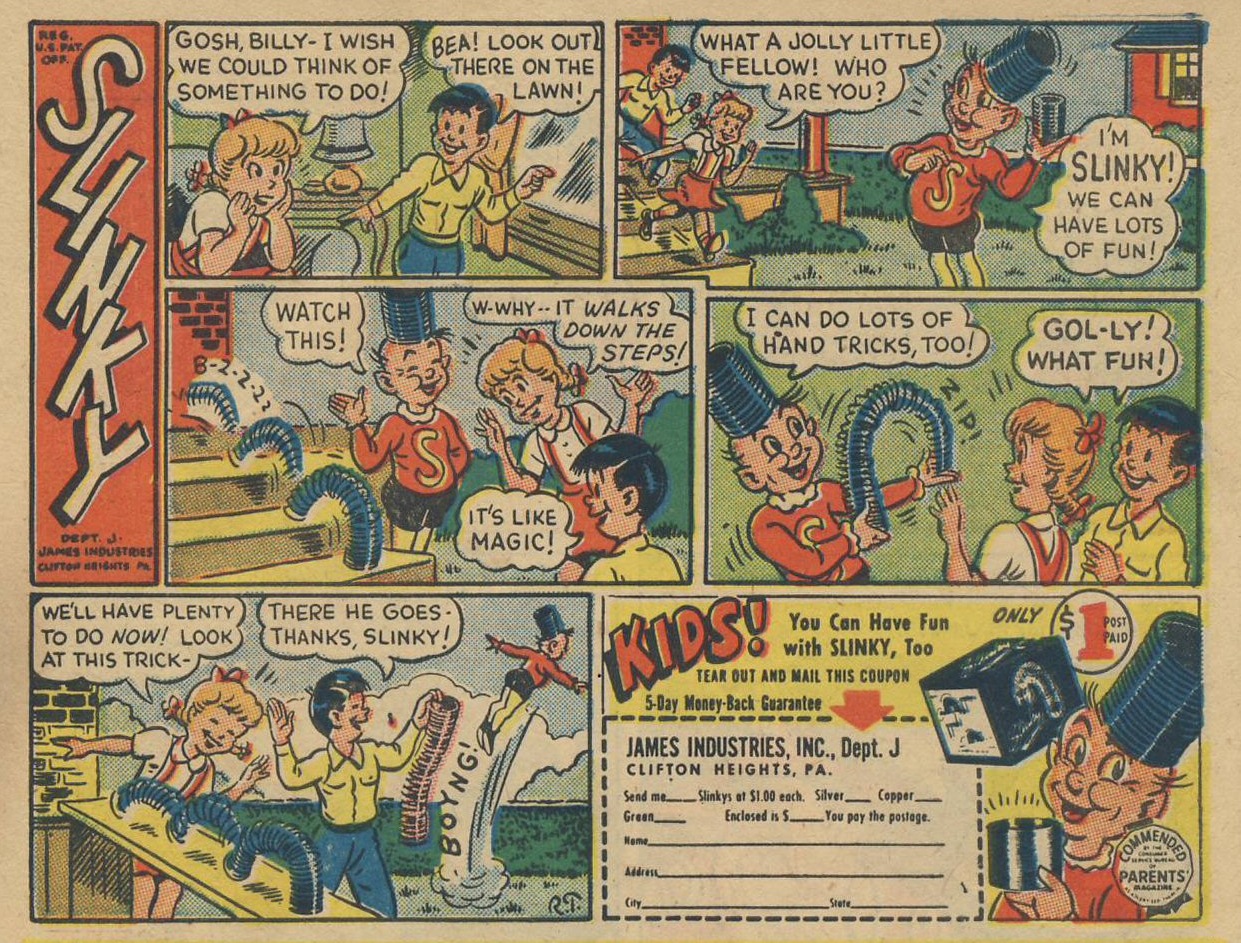
Here’s an ad for the Slinky from a 1953 Abbott and Costello comic book; it appears to have been drawn by the artist who did the Dubble-Bubble chewing-gum ads:
That Elusive Popeye . . .

Leave a comment

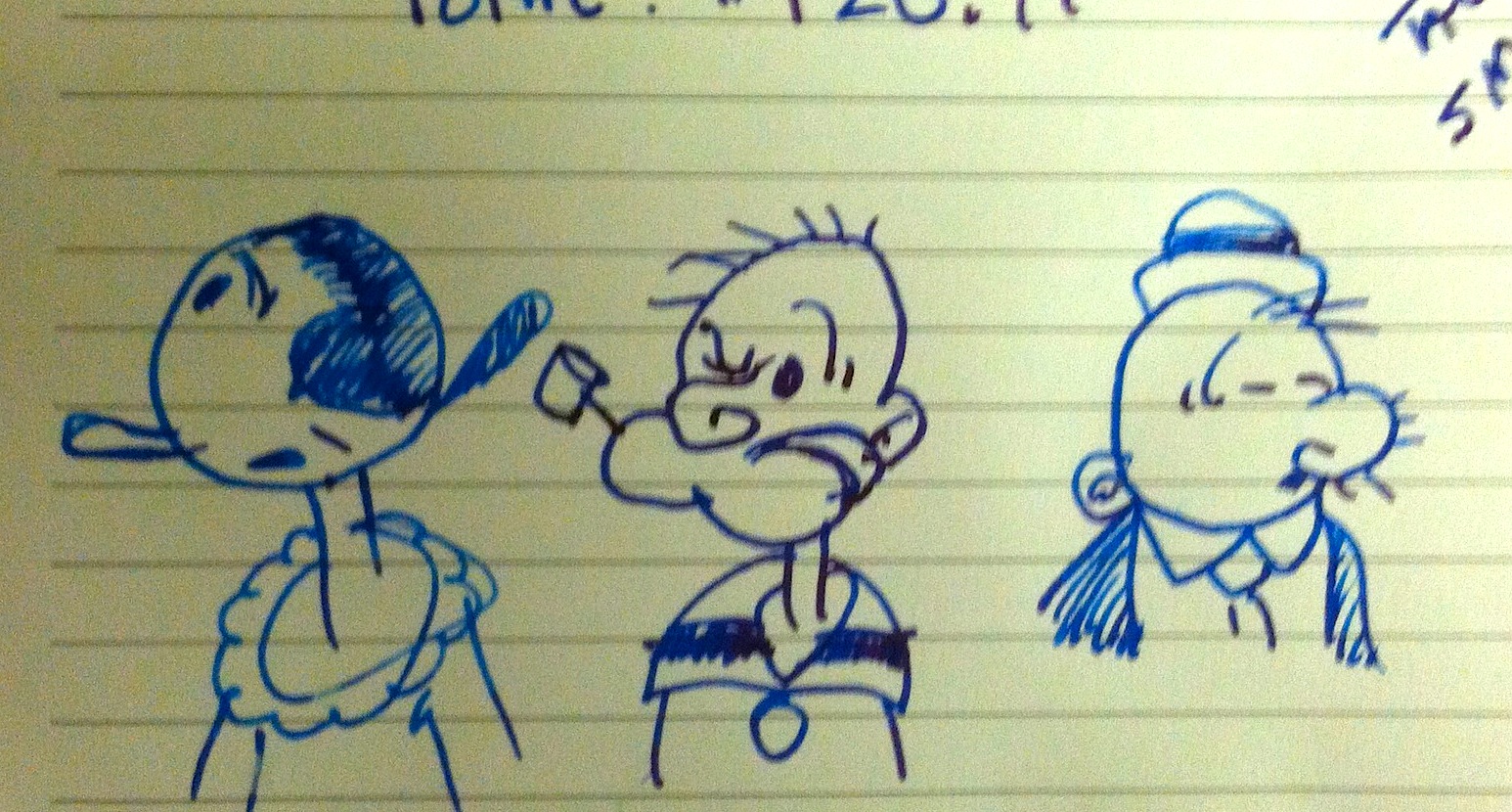
I hate to brag, but I must get this off my chest: While I should have been paying attention to what was going on around me, I finally succeeded in drawing a picture of Popeye that actually looks (somewhat) like him. Crazed with success, I then added Olive Oyl and Wimpy. I was able to draw a creditable Dick Tracy in the first grade, and have a dated colored-pencil rendering from then to prove it, but Popeye has always been beyond my ability. Until now.

Those with a critical eye can probably detect the painstaking wobbliness of my linework and the hesitant feel of the effort, but I still am proud. The fact that I forgot to draw his arms doesn’t detract from the achievement, I hope.

The Parker 75 Pen

8 Comments

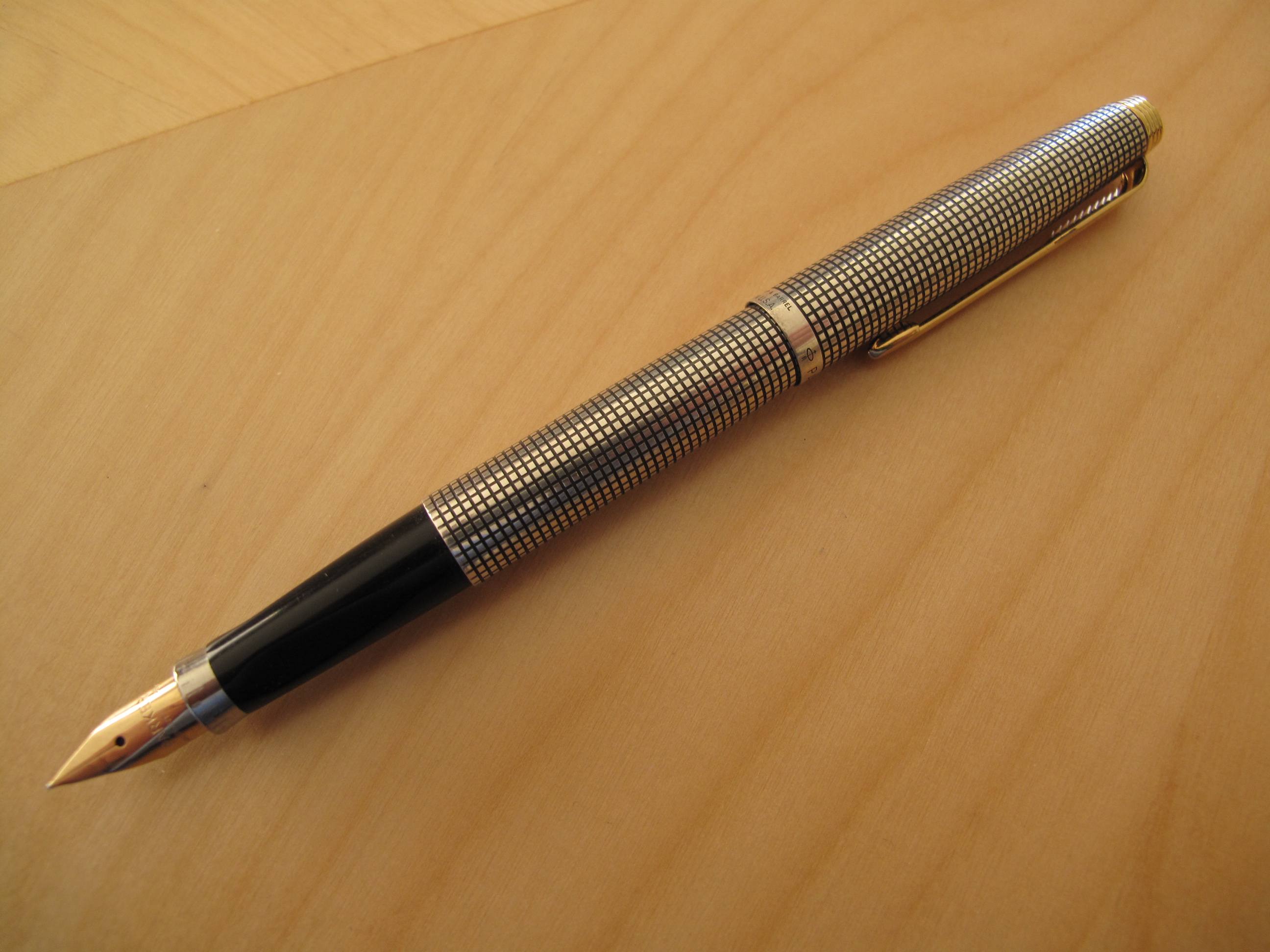
In 1964, to celebrate their 75th anniversary, the Parker Pen Company introduced the Parker 75. Mine belonged to my dad and is, I believe, from 1967. At the time, they sold for $25 which in today’s money would be about $200, I guess. On eBay, the sterling-silver ones, like mine, go for anywhere from $100 to $250, depending on what it’s made of, nib size and collectable status.

Mine is the sterling-silver model with the grid pattern, which looks very elegant and slim compared to many of today’s black and bulky fountain pens. I had my dad’s fine nib replaced with a Parker France broad nib, which is more like what we’d call a medium-thickness nib today.

Some of these pens were made in gold and other finishes, and some were made from 1715-era silver coins from a sunken Spanish ship found off the Florida Keys in the late 1960s.

When my brother (thanks, Jeffrey!) gave me this pen a couple of years ago, I had it checked out and the interior-grip cap mechanism replaced by our friends at Fahrney’s, which is a wonderful Washington, DC pen store. Their store is across from the National Press building on F Street, NW, and their repair facility is in Upper Marlboro, Maryland. Good folks. Send for their catalog!

These 75s take both the old-fashioned fill-from-a-bottle ink holders and modern-day ink cartridge refills. Tomorrow, I start a new print production assignment at one of my favorite places, so I’ll celebrate by using this pen, filled with the Parker emerald-green ink, which they call Quink for some reason.

Fountain Pens And A Bit Of Doggerel . . .

2 Comments

I like to use the old-fashioned fountain pens. Always have. Here’s the nib of one of my favorites; a Parker Duofold Centennial:

In my mechanical drafting, cartographic and drawing days, I had to use either a ruling pen (the less said about those abominations the better) or the old Koh-i-Noor Rapidographs with India ink. Those were a nightmare if you allowed the India ink to dry and had to clean the pen. And you would and did! In high school, a girl I wanted to date turned me down because my fingernails always looked dirty; I told her it was the darned India ink that kept my fingertips ink stained and was the very Devil to clean. So it goes . . .

A normal fountain pen with normal ink is a lot easier to manage, though I’ve still had a couple of accidents when I’d forget to cap the pen before sticking it back into my pocket. Then you walk around the office with a big blob of ink on your shirt. Luckily, dry cleaners are used to removing those stains!

Now, there was a stretch beginning in the late 1970s where I was filling out FedEx counterfoil labels all the time, and, for that purpose, a fountain pen isn’t the right tool. Reluctantly, I switched to a MontBlanc rollerball pen, but once FedEx labels could be generated online and printed on a laser printer, I went back to fountain pens.

What attracts me to fountain pens are the feel of the pen on paper, the infinite variety of inks available for them and the lovely designs available. The history of the things is overwhelming and it’s fun to look into that.

My collection isn’t extensive; I have a couple of each by the major manufacturers. I prefer a wider nib or pen-point than most folks do and that’s easily achieved with fountain pens.

Here’s the doggerel I promised. It’s from a pen-nib manufacturer in Scotland or England many years ago and at one time, signs with this verse were evidently all over the place in the UK:

Here’s what a box of those nibs looked like.

I still have a few boxes of that type of nib from my high school and college days. The ones I have are made by Speedball or Hunt, but they look just like the ones in that sign.

Jim’s Nature Corner: Know Your Moths!

2 Comments

If you’re anything like me, and, after all, who isn’t, you don’t know enough about our friends, the moths. Admit it!

Here’s one I see every year by my front-porch light:

It’s the Ailanthus webworm moth and is about an inch long. Its coloring reminds me, from my scuba-diving days, of a little clown fish, not found by my front-porch light but nonetheless darned attractive and quite friendly:

According to Wikipedia, these pretty moths are originally from South Florida and now found all over the country. They do no harm and are known for their biting wit, ability to sing in a four-octave range, and have a life span of up to 122 years.

Okay, I made up the last three items but they are still an interesting little creature and I look forward to seeing each year’s new batch. From my own observation, they do have the ability to stay in one place for days at a time.

Who Killed the Burma-Shave Poet?

Leave a comment

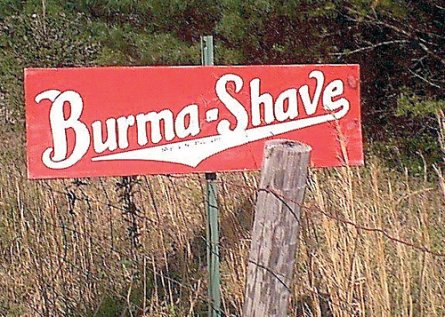
Actually, Burma-Shave brushless shaving cream, sold in tubes or jars, died from the growing popularity of shaving cream packaged in aerosol cans, and their advertising signs were killed by the growth of the U.S. interstate highway system. Drivers were moving too fast after that to read the Burma-Shave signs.

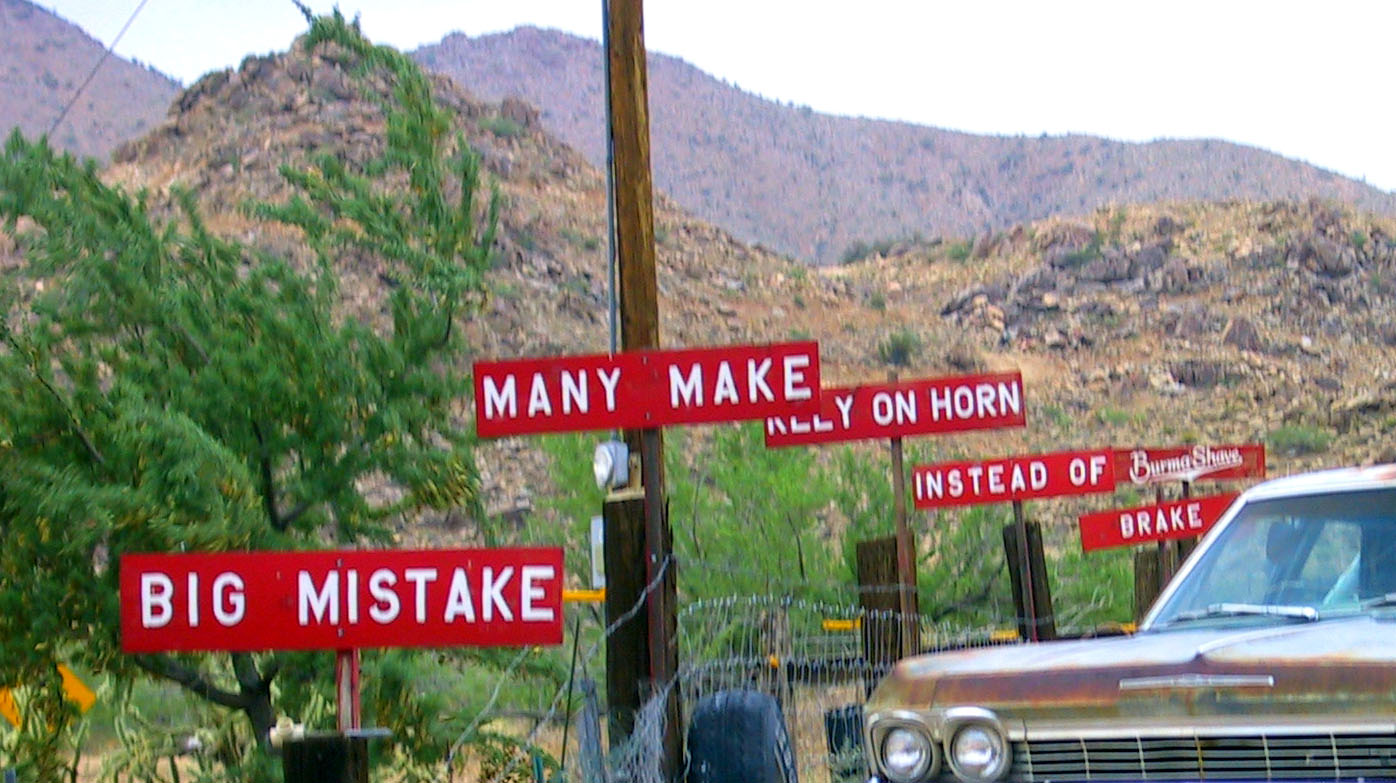
But, as a marketing guy, I have to admire the spirit and fun of the Burma-Shave signs, which were sequential red-and-white signs along the sides of roads during the period from 1925-1963. They were usually a comic verse, and during the time they were used, they were the most effective marketing device known.

Here are some examples of the more than 600 verses used to sell Burma-Shave. You can find plenty more on the Web.

Within this vale
Of toil
And sin
Your head grows bald
But not your chin–
–Burma-Shave

Eeny-meeny
Miny-mo
Save your skin
Your time
Your dough–
–Burma-Shave

When the stork
Delivers a boy
Our whole
Darn factory
Jumps for joy–
–Burma-Shave

If you
Don’t know
Whose signs
These are
You can’t have
Driven very far–
–Burma-Shave

The big blue tube’s
Just like Louise
You get a thrill
From every squeeze–
–Burma-Shave

The tube’s
A whopper
35 cents
Easy shaving
Low expense–
–Burma-Shave

From New York town
To Pumpkin Holler
It’s half a pound
For
Half a dollar–
–Burma-Shave

Many signs cautioned drivers to drive safely.

If daisies are your
Favorite flower
Keep pushing up those
Miles-per-hour–
–Burma-Shave

Thirty days
Hath September
April, June
And the speed offender–
–Burma-Shave

What you shouted
May be true
But
Did you hear
What he called you?
–Burma-Shave

Past
Schoolhouses
Take it slow
Let the little
Shavers grow–
–Burma-Shave

Don’t lose
Your head
To gain a minute
You need your head
Your brains are in it–
–Burma-Shave

A man
A miss
A car–a curve
He kissed the miss
And missed the curve–
–Burma-Shave

My favorite:

A peach
Looks good
With lots of fuzz
But man’s no peach
And never wuz–
–Burma-Shave

Why were these signs and slogans so effective? They were funny; people slowed down to read them. Folks talked about them and remembered new ones they’d read or old favorites. A very effective job of advertising! They made consumers feel like friends.

There Were Giants In Those Days . . .

5 Comments

I mentioned silver dollars in my last post. It occurred to me that younger readers may not be familiar with the old U.S. silver dollar coins, which were big (an inch-and-a-half in diameter) and heavy.

They were the biggest coins the U.S. Treasury ever made and were quite impressive. You didn’t see them in circulation all that often, but kids got them for Christmas and I heard that in Las Vegas, the slot machines were made to handle silver dollars.

They were solid silver, or close to it, for many years and had an impressive ring if you dropped one on a table or floor.

My dad had a friend, an old boat captain, who would come by if I was sick and give me either a silver dollar or a Mexican one-peso coin, which was the same size and was also legal U.S. tender for at least a while, as I recall; I know they were accepted at some stores I shopped at in Texas, valued the same as a U.S. silver dollar.

It’s About TIme!

Leave a comment

Back in the early 1960s, there was a lot of interest in time capsules. Usually these were a big deal and there were World’s Fair time capsules, scientific-society time capsules, and, of course, home-made ones. I buried one, made of a big metal coffee can, in our backyard in 1961. That was the year JFK was inaugurated, and I thought it was the beginning of a brave new world.

Being nine years old at the time, I chose what was important to me for my gift to the people of the future. I remember stuffing a Superman comic book into the can, some toys, and a couple of silver dollars I had saved. It was fun imaging how impressed people of the year 2061 would be when they found it!

Of course, my brother and his troops could have dug it up a week after I buried it for all I knew. But it was something to have fun doing.

Fast-forward to today. Remember the post a couple of weeks ago where I identified the home we lived in 50 years ago? Well, I just sent them a letter telling them about the time capsule. Photos taken in 1961 show them where the thing was buried, and I told them if they found anything at all, they were welcome to it.

Whether or not they’ll find anything, or do more than simply toss the letter in the trash, I can’t say. If nothing else, they may get a kick out of seeing what their home looked like over 50 years ago. But if anything interesting turns up, I’ll share it here!!!

UPDATE:

As of the end of November, three and a half months after I sent the letter to the folks at our old address, the people there haven’t responded.

Sorry, Kid . . .

3 Comments

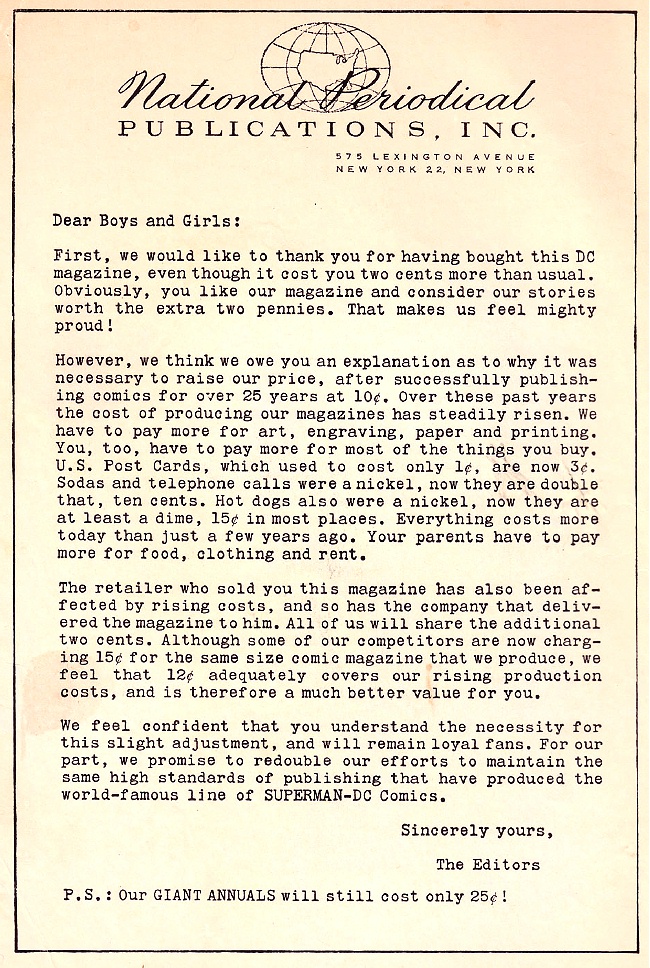
Here’s the announcement DC Comics had on their inside front covers in December, 1961, announcing their 20-percent price increase to twelve cents an issue. I can clearly remember that, though I was only nine years old at the time. Notice the prices of other items DC mentions in this “letter” to the boys and girls who bought the comic:

Of course, the other comic publishers quickly jumped on the bandwagon; Dell Comics, who outsold everyone with their Disney/Warner Brothers-licensed comics and movie/TV-adaptations, went to fifteen cents for a 36-page comic earlier in 1961, at least for a while. From the sales figures I’ve seen, and some folks have published a lot of info on this, sales of comics went into a decided slump after this increase and the slump lasted for a long time. Marvel had just begun their superhero output with the Fantastic Four, but one of their pre-hero monster comics lost 30-percent of its sales.

Today, when a DC or Marvel Comic costs three or four dollars, a couple of pennies doesn’t seem like a big deal, but it was to a kid back then.

For our younger readers, here are some common prices and such from 1961, by way of comparison:

Average cost of new house: $12,500.00
Average income per year: $5,315.00
Cost of a gallon of gas: 27 cents
Average cost of a new car: $2,850.00
23″ black-and-white television: $219.99
Bacon, one pound: 67 cents
Loaf of bread: 20 cents
Eggs, per dozen: 30 cents
Ounce of gold: $35.25

Great Scott!

Leave a comment

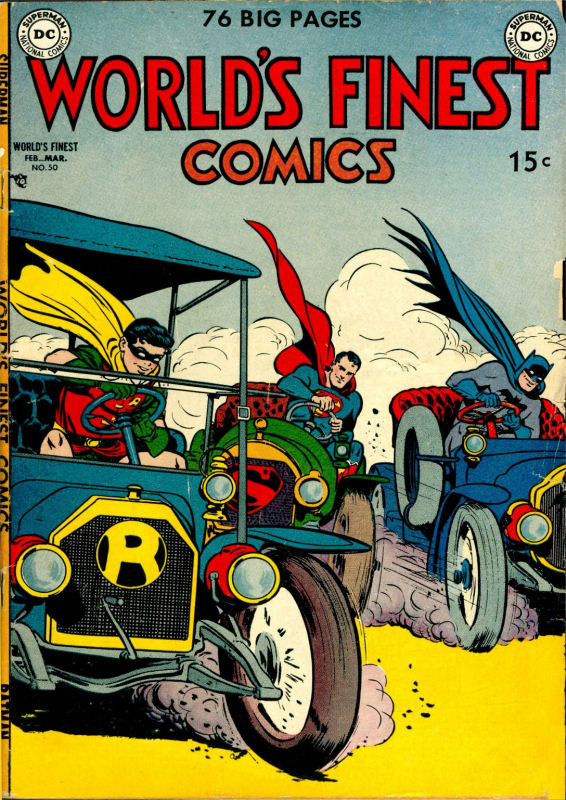
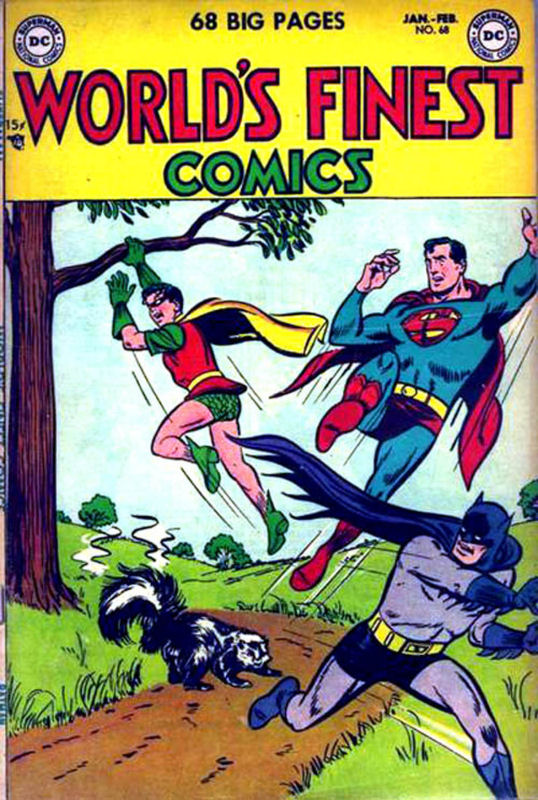
As a kid, I loved comic books and the one I loved the most was DC’s World’s Finest Comics. It had originally started as New York World’s Fair Comics, in 1939. Then it became World’s Best Comics and finally World’s Finest Comics. Its early issues were 96-pagers, but soon settled in at 76 pages for fifteen cents for many years. Superman and Batman each had their own stories, along with a bunch of lesser characters.

The covers showed Superman and Batman together in a poster setting that had nothing to do with the contents of the books. All this was way before my time. The page count began slimming down by the late 1940s, as seen here, but the price stayed at fifteen cents. I have to wonder how many of these comics were sold at a dime, since that was the going rate for a comic book.

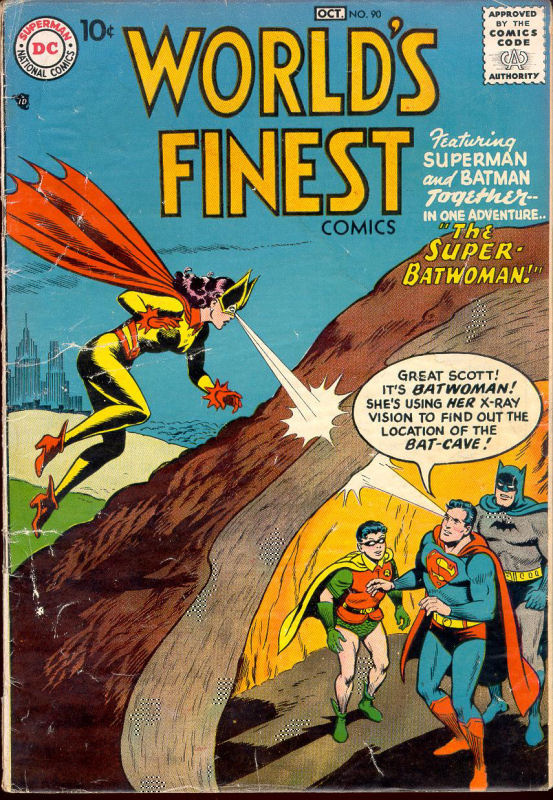
In 1954, when things got tough for comics publishers, DC changed the format to 36 pages (including the covers), cut a lot of the secondary features and reduced the price to ten cents, like most all other comics. They also combined Superman and Batman into one story, which seems an obvious move after all those previous covers showing them both together. Those are the comics I loved; they gave great value for your dime. The art was crisp and well-drawn; the stories were interesting with intriguing plots. And the idea of superheroes being friends was wonderful to a kid.

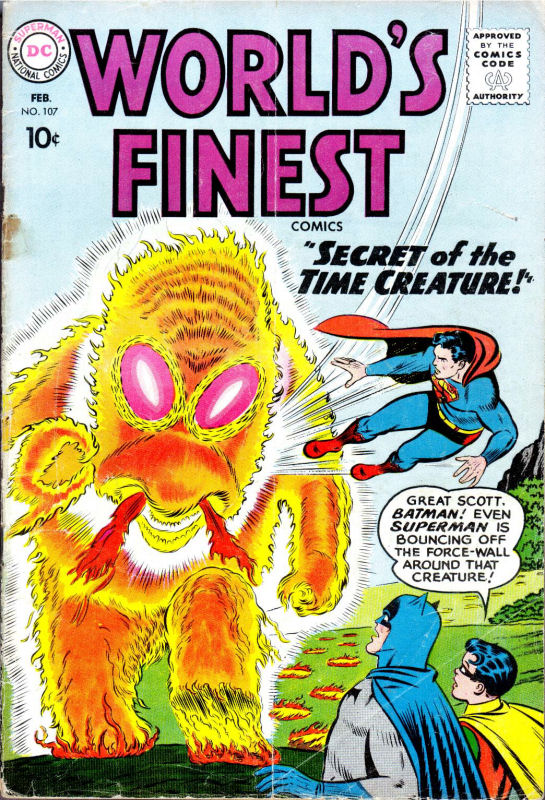
The Justice League of America, which came out a few years later, had most all the DC heroes, including Superman and Batman, but the art was lame and the stories confusing with seven or eight heroes bouncing around. World’s Finest was more to my liking. Now, too, the covers related to the stories found in the issue.

For about 50 issues, World’s Finest Comics were a real hoot, and there were two things about the covers I really liked. Usually, someone (Superman, Batman or Robin) would exclaim, “Great Scott!” at whatever was going on.

And Robin, being rather a fifth wheel, would often be stuck in the bottom corner of the cover.

My favorite covers had both the Great Scott! AND Robin in the corner.

I don’t believe I’ve ever heard a real person say, “Great Scott!” but comic books were aimed at 12-year-olds, and the publishers had to be careful. The very early Superman used a lot of “What the–“ exclamations, and the reader could fill in the blank but that only lasted a couple of years. Thus, “Great Scott!” And see that “Still 10¢” in bold type on the pink cover? That was a hint that something was in the works at DC, and it wasn’t good.

After a while, someone at DC must have issued an order about these recurring items, and Great Scott! was replaced with a couple of Great Kryptons! or Great Guns! and once even with a Great Gosh! Robin, instead of being stuck in the corner, was just left off the cover entirely as often as not.

By then the comics had gone up in price to twelve cents each (that previously noted “Still 10¢” really meant “Not Yet 12¢”) and the art wasn’t as lively or well-drawn as it had once been. It was the end of an era.

Older Entries Newer Entries