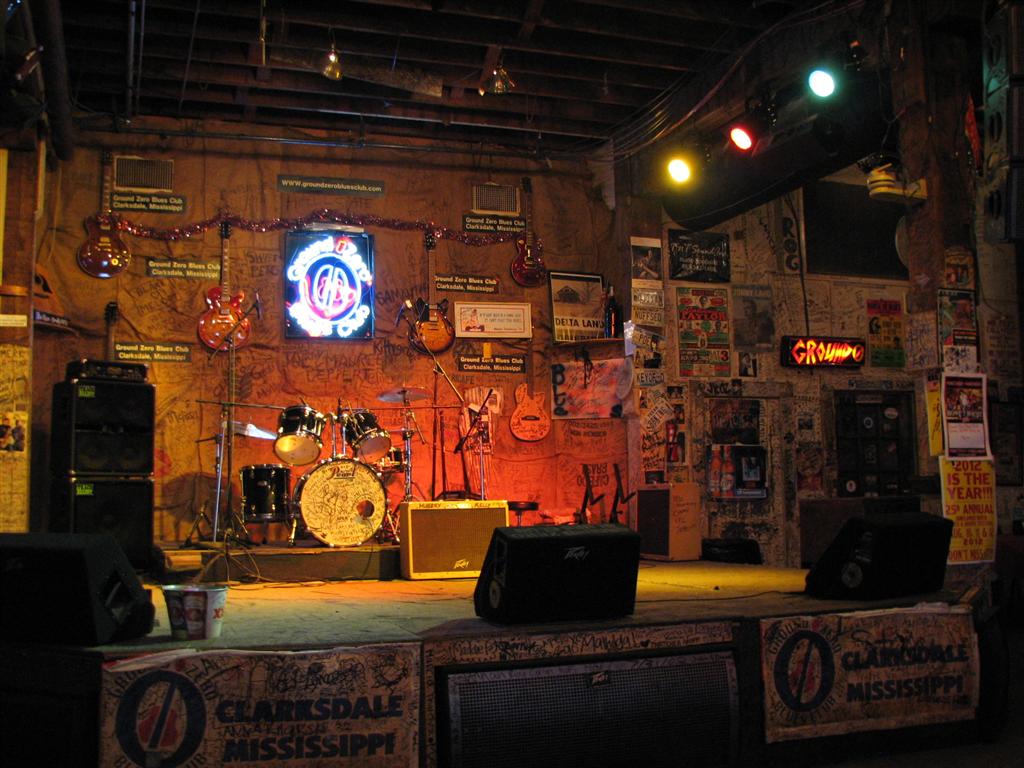
My great friend from Nashville, John Beasley, created an amazing blog that takes you on a tour of blues-related sites in the Mississippi Delta.
Beaz knows whereof he speaks. He’s a talented singer and player, and makes the best margaritas you can imagine. He can do anything in the world except teach me how to play Deep River Blues as well as he does.
You will enjoy the trip through the Delta with Beaz as your guide; that I guarantee.
The photos shown were taken by the Beaz and show the outside neon sign and stage at Morgan Freeman’s Ground Zero juke joint in Clarksdale, Mississippi.
A wonderful 1986 Walter Hill film, Crossroads explores the relationship between a Julliard-trained college boy who loves the blues (Lightnin’ Boy, played by Ralph Macchio) and Willie Brown (played by Joe Seneca, who shared a birthday with yours truly).
The plot is that Willie, like his friend and mentor, the blues legend Robert Johnson, sold his soul to the Devil– at a crossroads, of course– in order to be the best harp player in the world. Lightnin’ Boy will try to save Willie’s soul (and his own) by winning a haircutting guitar duel with the Devil’s guitar player, Jack Butler, played by the astonishing Steve Vai.
Here’s the duel, which is actually played by Steve Vai with Ry Cooder playing Macchio’s part, or at least the bottleneck portion of it. I’ve heard so many conflicting stories about who played exactly what in this sequence that I don’t believe anyone except Cooder and Vai and maybe the film/sound editor knows for sure!
Macchio’s hands are obviously sped up in the Peganini’s Caprice #24 section but he does a rather nice job of mimicking the actual hand positions. He was coached by Arlen Roth, who has a ton of great instructional materials available on many aspects of the guitar. The harp playing in this clip is by blues great Sonny Terry, whom I was lucky enough to meet in Tampa one night in 1972.
Macchio’s “playing” a ’70s maple-necked Telecaster (either an American Standard or a Japanese Squier; no skunk-stripe on the back of the neck) in this, while Vai “plays” a red variant of his trademark Jackson whammy-barred specials. Most folks say Vai played his portion of the actual duel on his heavily customized “Green Meanie” Charvel guitar in the studio.
This is, to my knowledge, the ultimate guitar-playing scene in any flick. Some ’60s albums used to be labeled, “Play it LOUD;” I recommend “Play this video FULL-SCREEN!”
I have always been attracted to oddball guitars, and have had a bunch of them. However, the three classic electric guitars– the Fender Stratocaster, the Fender Telecaster and the Gibson Les Paul– were ones I always passed up. Maybe it was because they were so frequently seen; I don’t know. These three icons of the guitar world were all developed between 1950 and 1954 and a lot of companies have either copied them outright or made their own variations of them. More on that in a second.
In the last couple of years, as I amble into my dotage, I finally gave in and got a Stratocaster (though not a Fender; more on that in a second, too!) and a Tele (made by me from various old-timey Fender parts). The Telecaster is now my favorite electric. For those of you who don’t play guitar, there’s a big difference between acoustic and electric guitars; in my mind, they are two different instruments. I started on bass, coming to guitars as I did from playing a baritone sax, and then mainly played acoustic guitars.
For some reason, guitar players develop an affliction called Guitar Acquisition Syndrome, or GAS. I try to ignore it, but seeing rows of Tolex guitar cases all over the house proves I came down with GAS a long time ago. I guess I still have it, though I try to keep it in check.
My latest GAS object of desire is a Les Paul, but not just any old Les Paul. The one I want is a type that Gibson made for only a few years: The Fretless Wonder Black Beauty model. Its official designation is the Gibson Les Paul Custom, and it was originally made from 1954 to 1960. These originally sold for about $350 but command astonishing prices now– say $15K or so. I saw one for sale on the Net this morning for $37K. And most of the ones I’ve seen in person have been modified with taller frets. I play with a very light touch and the original flat, tiny frets would be perfect for my style of playing; most players today hate those kind of frets and have them changed to the more modern type.
Since the original Fretless Wonders are so pricey, I looked into Gibson’s “Historic” and Vintage Old Stock reissues of those guitars. Even those are past the $3K mark; I’ve seen some selling for over $7K. Yeesh!
Now Gibson Guitars realized several years ago that their prices for guitars built here in the U.S. and built using the original materials and finishes were beyond the reach of most players. And as the quality of the American-built Fenders and Gibsons declined– and they surely did when accountants controlled the companies–Tokai and a few other Japanese companies blueprinted the original classic guitars and painstakingly reproduced them by hand. Gibson and Fender both gave in and had their own Japanese contractors make guitars for them, and they are quite good. I have a Japanese Fender reissue of a 1951 Precision Bass that is a beautiful instrument. And the Stratocaster I got a year or so ago is one of the early-’80s Tokais and it is a spooky-good recreation of a two-color sunburst 1956 Strat– just like the ones Buddy Holly used to such good purpose.
So I looked at the Tokai versions of the 1950s Les Paul Customs. They’re beautiful and exact copies of the Gibson Les Paul model I want, but even those are selling now for over well over $2K. And, being a crazy GAS-afflicted guitar player, I wouldn’t be satisfied unless the Les Paul I got was one of the tiny-fretted, fat-necked gloss-black nitrocellulose-lacquer-finished Les Pauls! Really!!!
So to heck with it. No Les for me. As I struggle to find a permanent day job in this frustrating economy it makes no sense to throw that kind of money at a guitar. Besides, Patty has learned to count those hardshell Tolex guitar cases and I am scared of her. But can you imagine how wonderful it would be to have a black Les Paul ’58 Custom that matches Murphy, my Boston terrier?!?!?!
Les Paul presents Paul McCartney with a custom lefty Les Paul.
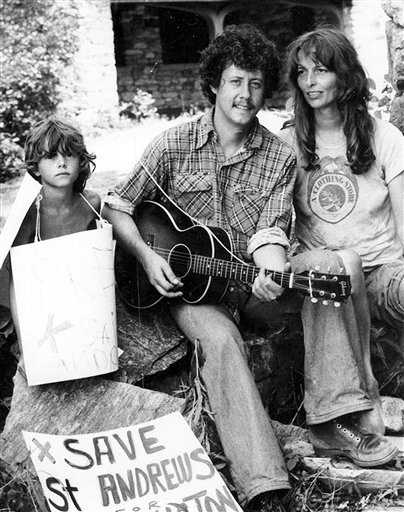
I heard of Jackie Guthrie’s passing yesterday when Rip Tragle, a friend of the Guthrie family and a member of the Shorpy community, posted this lovely photo he took at Jackie and Arlo’s wedding, back in 1969:
I didn’t want to post the image here without Rip’s kind permission, but he granted that just now and I’m pleased and honored that he did.
The title of this blog entry is from a series of bumper stickers that my old friend John Pearse used to give away when someone bought his guitar strings or accessories. Lord knows I bought a bunch of both, and once even bought a high-end Martin guitar from John, but the sticker he created is what’s on my mind today and John may have had the Guthrie family in mind when he wrote it. It seems to be very apt when considering the passing of Arlo Guthrie’s wife, Jackie. They were married for over 43 years.
The Guthrie family has consistently used music as a way to make the world in which they found themselves a more human, more kindly place.
What they had to say may not have always been politically correct, and I may not have agreed with every position the various members of the Guthrie family took, but no one could say that they didn’t do more than their share to help others find happiness and peace.
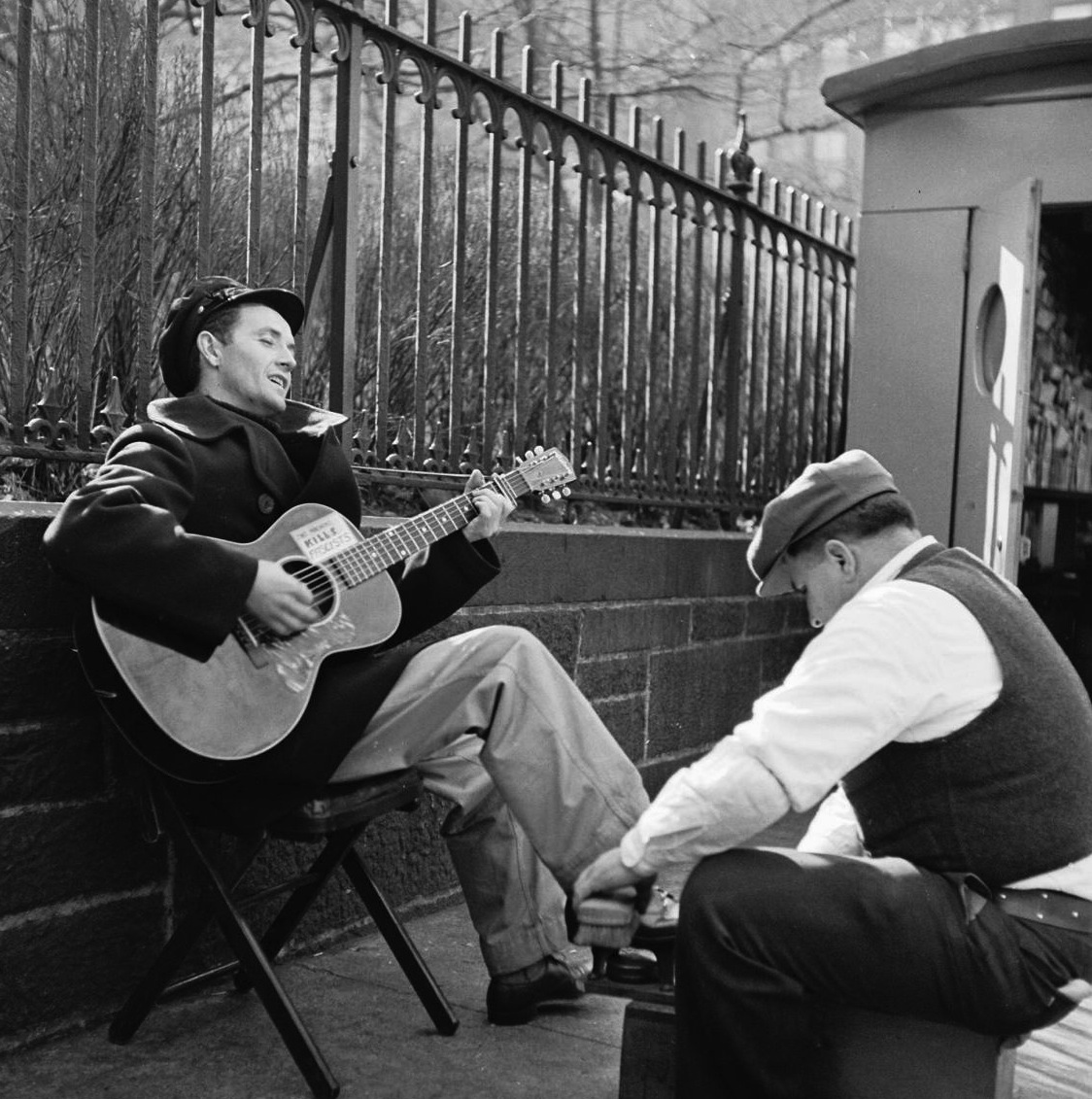
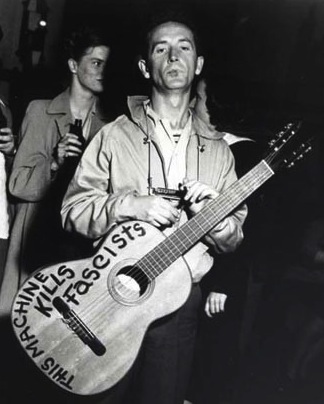
Woody Guthrie’s famous statement, placed prominently on his guitars, remains a touchstone for why many people picked up the instrument in the first place. Woody’s musical and philosphical DNA has spread over much of the world and many folks may not even be aware of it. But they owe him.
Arlo came into most of our lives through his wise and witty 1967 song, Alice’s Restaurant, properly titled Alice’s Restaurant Massacree, and that song was a breakthrough on many levels. It was funny, fact-based and a fingerpicker’s joy. So infectious and joyful was his playful delivery that it may have masked the more serious message of his words: Official America can sometimes be a blind lumbering beast that can step on people unless someone shouts a warning.
I recall playing that record for my dad, who had no taste or interest in music and was an outspoken opponent of the “hippy” movement or anything that smacked of a lack of respect for authority. Dad tried hard not to laugh as the song progressed but at the mention of “mother stabbers and father rapers” he surrendered and enjoyed himself and the song. I couldn’t believe it. Dad had let his short hair down, if just for the duration of a song!
So today we remember the Guthries and all they have meant to us. For those of you who haven’t listened to the music and message of the Guthries– Woody, Arlo and his and Jackie’s children Abe, Sarah Lee, Cathy and Annie– I encourage you to please take the time to do so. And here’s Arlo’s website: http://www.arlo.net/
Their world is our world and it’s a wonderful place to be.
Great clip of three of my favorites live at The Odeon in NYC in 1983: Linda Ronstadt, Randy Newman and a slicked-down Ry Cooder. I have the complete performance on VHS somewhere but no way to play it.
Here’s their version of Mr. Newman’s Rider in the Rain from his Little Criminals album. On the record, he’s backed up vocally by The Eagles, who started as Ms Ronstadt’s backup band.
This clip is a great example of what I believe is a good rule for music and other things: Take the prep and practices seriously, but have fun with the performance. It’s obviously sung in a key that isn’t Mr. Cooder’s first choice, but I love what he does with it.
When Patty, her brother Billy and I saw Randy Newman at the spooky old Tampa Theater live in the 1970s, he worked solo. He is so talented and tuneful.
In George Martin’s memoirs of his days with The Beatles, he describes visiting Mr. Newman at a jingle factory in LA. He had been sent by The Fabs to recruit Newman as their first Apple Records artist. Newman turned Mr. Martin down, as writing jingles on demand was steady work and he had a family. The Beatles chose James Taylor instead for an Apple release, and he’s done pretty well!
I first heard of Ry Cooder when I was in high school; he was a session player on a couple of the better Stones albums (Let It Bleed and Sticky Fingers) and on their jam session LP, Jamming With Edward. Then a friend gave me a tape of an album Ry did with Taj Mahal; they called themselves The Rising Sons.
As a geek who studied the liner notes on albums like they were the Dead Sea Scrolls, I kept seeing this name come up. When Rolling Stone magazine started coming out, I’d see his name all the time. I’d search out his work on the albums at the Record Bar in Naples; his stuff was there, if you knew where to look.
His first album, Ry Cooder on the old Reprise label, came out in 1970 and was astonishing. It wasn’t just the tasty playing on guitar and mandolin, it was the TYPE of songs he chose to do. Cooder was all over the place, with a seemingly encyclopedic knowledge of any kind of music, past and present. He could play it all and play it better than anyone else. He’s done so many great albums. Once, when my old VW van was broken into, they stole all my eight-track tapes except for Ry Cooder’s; I guess the villains weren’t familiar with him. I was glad that they left the best music I had behind!
Mr. Cooder is also responsible for what may well be the best soundtrack album ever; it’s of the music he did for the movie, The Long Riders. Here’s a taste:
Here’s a spectacular clip from a Record Plant show in 1974. When they start showing him playing, about 43 seconds in, watch his hands on Blind Blake’s Police Dog Blues:
As you continue watching, and I surely hope that you will, please pay particular attention to the little fills or transistions he throws in between the sung verses. Uncanny. He’s playing what appears to be an old O-sized Martin acoustic at first and then switches to a hardtail Strat with a bound ebony fingerboard.
I have a magazine-editor friend (hey, Charlie!) who used to jam with Ry occasionally. He told me that the strings on Cooder’s many guitars are set so high off the neck that no one else could play them. If that’s the case, then Ry Cooder must have the strongest pair of hands on the planet.
It seems odd to me that a person playing a high-action guitar can have such a delicate touch. If I had to choose one word to describe Mr. Cooder’s playing, it would be majestic. Listen to his version on that video (it begins at the 6:23 mark) of the 1929 tune by Blind Alfred Reed, How Can a Poor Man Stand Such Times and Live, and see if you don’t agree. That song’s on Cooder’s first album, too.
If you just have heard of Ry Cooder as the guy who put together the Buena Vista Social Club movie, you are in for a treat.
Music is a big part of my life. My aunt bought me a little kid’s record player before I went into the first grade, and she provided three 45 records with it: One was Elvis, one was Patty Page, and one was country singer Claude King. Stunned me; I had listened to radio, but being able to pick what I wanted to hear played opened up a new world.
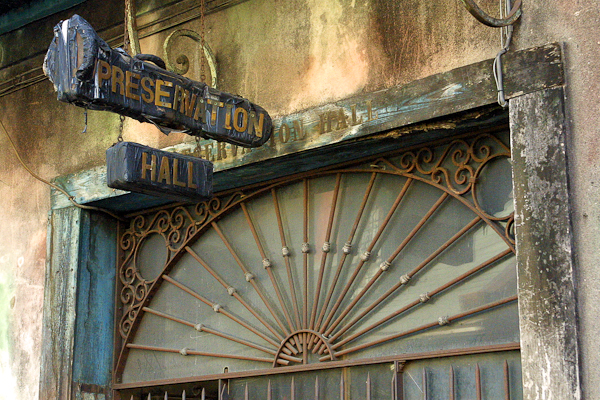
Later, as a third grader, I was walking in the French Quarter of New Orleans one afternoon and saw a group of older men sitting in chairs on the sidewalk, jamming on some blues tune. I was gobsmacked; you mean regular folks can make their own music? Astonishing! Soon I had my aunt’s alto sax and was trying to play what I heard from those guys at Preservation Hall. It was so difficult to learn to play but that was part of the fun.
Seeing The Beatles on TV one Sunday night in early 1964 was another seminal event; I knew I’d switch from sax to guitar and bass.
Here are some of my musical buddies last night, playing in John Sapper’s backyard gazebo in Silver Spring, Maryland. We have a group of perhaps a dozen friends who get together most weekends to jam and sing. We call this assemblage The Usual Suspects, and we never know who will show up.
Last night, at John’s, it was John, Dan Collier, David Martin and me. I had already packed up my Telecaster when this song began, so I filmed it with my iPhone:
I belong to a more conventional band called The Gizmos, which plays blues, Bakersfield country, rockabilly and classic rock. I’ll try to get some video of that group soon!
I found this on YouTube today and can’t stop playing it. It’s from the early-1960s and had Barbara Lynn and her band live playing You’ll Lose a Good Thing:
Please notice that’s she’s playing, not a Telecaster, but a Fender Esquire– no neck pickup– lefthanded. Many folks don’t realize that Leo Fender’s original design for what became the Tele was what was later called the Esquire, as it was a bridge-pickup-only guitar.
If you think that band behind Ms Lynn is totally locked in a perfect groove, you’re correct! And what a band that is. On piano is Mr. Johnnie Johnson who played behind Chuck Berry on all his sides, and many believe he actually at least co-wrote many of the songs Berry took credit for. He was just a stunning piano player. He was inducted into the Rock ‘n’ Roll Hall of Fame in 2001 after Keith Richards waged a campaign for years for his inclusion.
On bass is Mr. Billy Cox, who was Jimi Hendrix’s first and last bass player. He’s played with everybody at one time or another and is still going strong. He was in both the Jimi Hendrix Experience and Band of Gypsies. He met Jimi when they were in the Army together and encouraged his guitar playing. That bass he’s playing appears to be a Fender Precision fitted with a Jazz Bass neck.
On the maple-glo Rickenbacker guitar is none other than Mr. Clarence “Gatemouth” Brown, who was a guitar legend. Originally a drummer, he got his first break as a very young man filling in for an ailing T-Bone Walker on guitar and never looked back. He’s in the Blues Hall of Fame and may be better known in Europe than he is here in the States. Guitar-slingers study Gatemouth Brown and take careful notes.
As for Ms. Lynn, she’s living in Beaumont, Texas, and still plays out regularly. I refuse to give her precise age, but she’s two days shy of being ten years older than yours truly.
Notice her left hand; she’s using a thumb pick and her strumming is almost all upswings. Also, that Esquire has a rosewood fretboard and she kept the bridge cover on it. Cool guitar– and a pink strap! Oh, YEAH!!! Ms Lynn plays a white Strat nowadays but I hope she still has that Esquire in a closet somewhere.
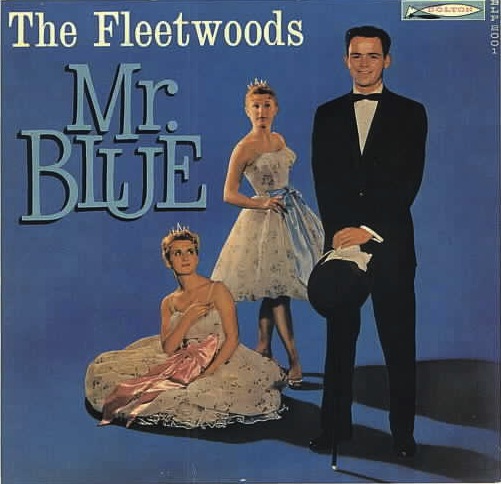
Anyone taking on the task of covering the 1959 Fleetwoods hit, Mr. Blue, has a big job on their hands.
The original version has a lead vocal by The Fleetwoods’ Gary Troxel, who originally auditioned for Gretchen Christopher and Barbara Ellis, the founding members of the group, as a trumpet player, and Gary is one of the smoothest singers of that era.
Here he and (I believe) Gretchen, joined by an unidentified background vocalist, do a live version of the song on the TV show Midnight Special 15 years after their single came out:
Still has his chops, eh? I’ve seen recent videos of him in the current incarnation of The Fleetwoods, and he still has the seemingly easy delivery he had as a teenager.
This great and evocative song is a bear to sing, especially if you’re playing an instrument at the same time. I’ve always ditched the spoken intro, which I consider a tad too hokey; Pat Boone’s cover from 1962 or so also ditched it. Interestingly, The Fleetwoods, who were from Washington state, I believe, always recorded their vocals accappella, and their LA producer would drop in the instruments later. Glen Campbell on guitar and Leon Russell on keyboards worked on their records, so they didn’t lack for talent!
Thanks to the magic of YouTube, we now have a lovely cover of this tune by a young fellow named Steven Oakland:
I have no info on Steven other than I envy him not only his vocal talents but the maple-necked sunburst Tele on the wall behind him in this video. He chose to use a Boss harmony pedal instead of background vocalists but otherwise he nails a very difficult project with elan. Why he hides his face behind his microphone and pop filter is a mystery.
As I continue my pointless research into the folks who designed, built and sold the guitars we know and love today, I come across some funny stories.
Last night I read about Hartley Peavey, who started the Peavey Electronics company in Meridian, Mississippi back in the mid-1960s. Like Leo Fender before him and the original C.F. Martin before Leo, Mr. Peavey was a shrewd person who knew the value of money and didn’t waste it when making his instruments or amplifiers.
The story I found funny was that Peavey and a young and innovative guitar builder named Chip Todd collaborated back in the 1980s on a new guitar. This guitar eventually became the first of the T-series Peaveys and are still highly regarded for their tone and playing ease. It was the first guitar to use computer-controlled wood cutting and shaping for the bodies and necks. Chip’s design called for a small metal slug to be in the base of the neck, to be the bearing point of a neck-angle adjustment bolt.
As the time came to produce the guitars, the metal slugs still hadn’t been procured, and Chip told Mr. Peavey that, for now, they’d use a nickel coin for the slug they needed. Mr. Peavey, the brilliant business person, replied, “No; use a penny.”
Here’s Chip in a recent photo as he rides a Segway in his living room:
Another story of these wonderful music-industry folks: There used to be some music stores in the DC area called Veneman’s Music. Great stores. Veneman’s also made and sold their own line of guitars and basses and most of us in this area owned some of those; they were good utility instruments. The owner of the stores and guitar factory was a Dutch-born gentleman named Koob Veneman. He was a sweet guy with a beautiful smile and we all respected Mr. Veneman. But he was all business!
I had lunch a few months ago with an old-time salesman at Veneman’s rival, Chuck Levin’s Washington Music Center, and he told us a funny story about Old Man Veneman, as he called him.
The salesman from Chuck’s was in Veneman’s Rockville, Maryland, store (now the Guitar Center on Twinbrook Parkway) and a young man was approached by Mr. Veneman, who said, “Hey, I recognize you. I sold you a Les Paul a few years ago. Do you still have it?”
The kid replied, “Why, yes, Mr. Veneman. I still have that guitar and I love it.”
And Mr. Veneman replied, “Well, I still have your $800 and I love that!”








 Jim's World and Welcome To It