Home

Gazebo Nights and Knights

1 Comment

Last night, four of us gathered, as we often do, under the gazebo roof at John Sapper’s place. We’re preparing an acoustic-music set for the 23rd Annual Adelphi Music and Arts Fest that Dave Martin puts on at his place.

The weather was pleasant, the insects weren’t too intrusive, and the grove of trees behind John’s gazebo made for a relaxing atmosphere.
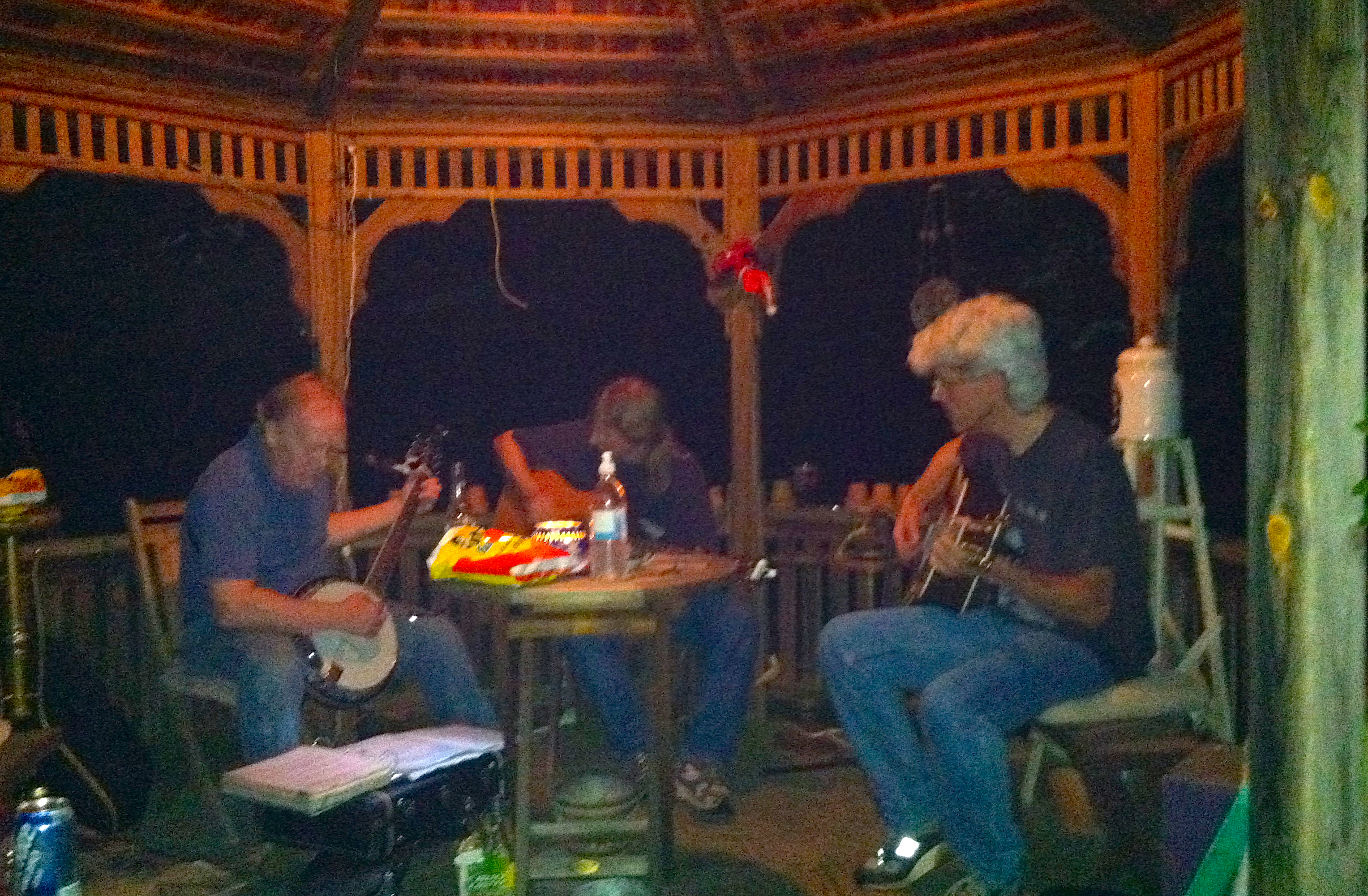
Here’s Dave Martin on his six-string banjo. Dave and I squabble like brothers; maybe because we’re as tight as brothers. We’ve been playing music and having adventures for a good number of years. As many of you know, Dave jokingly refers to himself as NFD (nine-fingered Dave) after a tragic woodshop accident in 2006. All of us were stunned when Dave was hurt, but none of us were surprised when he refused to let such a blow hold him down or keep him from playing music. If anything, his playing is better now than before the accident. Says a lot about the man:

Here’s John Sapper, our host for the evening. John is an absolute guitar wizard at tasty, perfectly articulated solos and has a deep repertoire of what he calls “fiddle tunes.” He augments these with elegant arrangements of classic and classy country and folk songs. His versions of Grandpa Jones’ Eight More Miles to Louisville and Are You From Dixie? are so good that I always insist on hearing them each time we get together, along with his flawless rendition of Machine-Gun Kelly. What a player and singer, and a genuinely nice guy. John’s playing his Santa Cruz here, for you guitar buffs out there, and he has a gorgeous old Gallagher guitar (think Doc Watson) I’ve been trying to sneak out of his house for years:
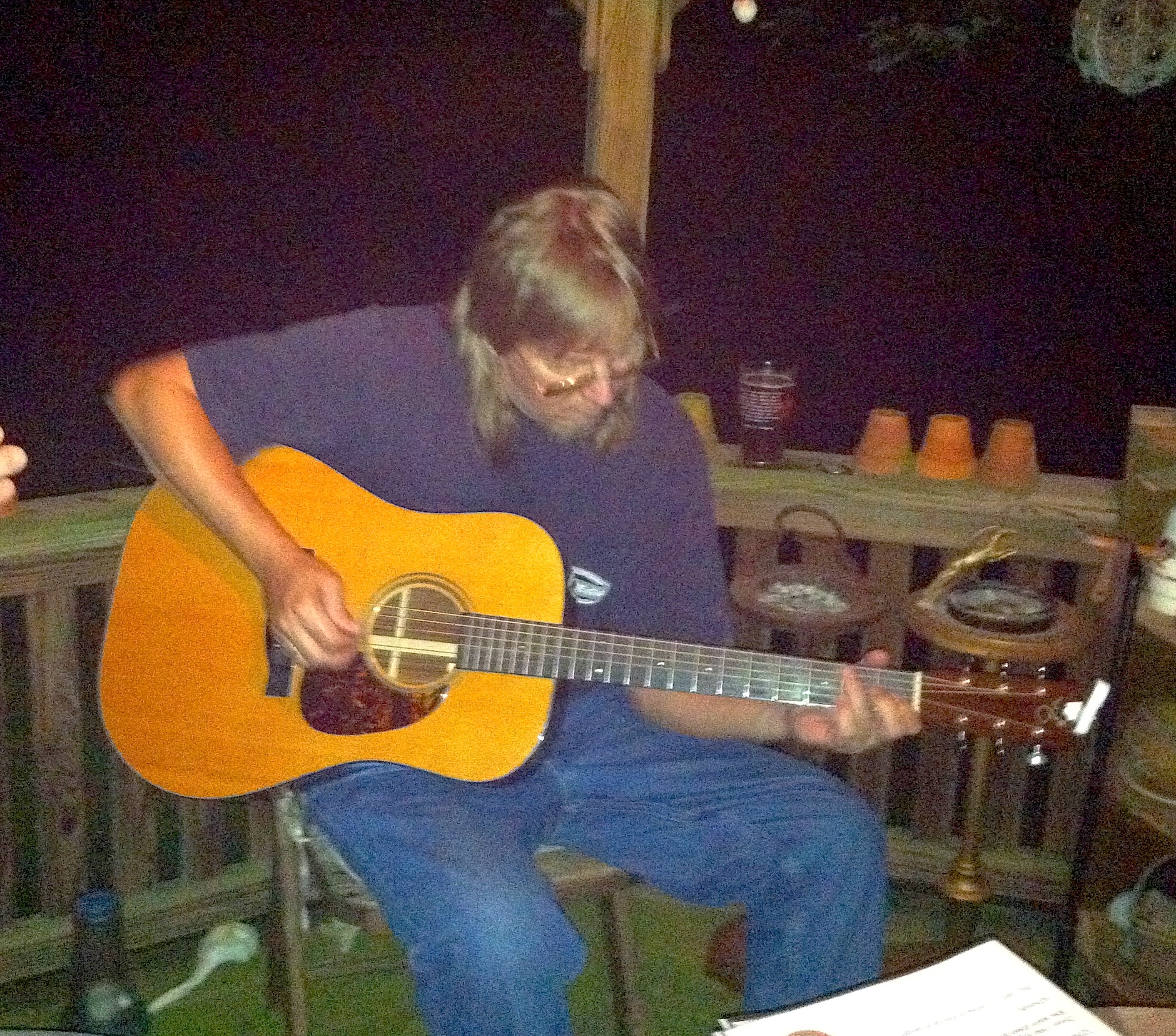
The most recent addition to our group is Doug Percival, seen here playing my cowboyed-up old Martin D-41, because we made him play some more after he had packed up for the evening. Doug’s singing and guitar playing are first rate, but we like him anyway. Doug has a knack for taking tunes you’ve heard a million times (or not) and reshaping them with novel arrangements and interpretations. He is also the only fellow I’ve met who, in a former band years ago, was flown by the U.S. military to Guantanamo Bay, Cuba, to play for a couple of weeks in the Naval Base service clubs there:

I think we’ll have a lot of fun next Saturday at Dave’s party and make some great music, too!

Flying Boats

12 Comments

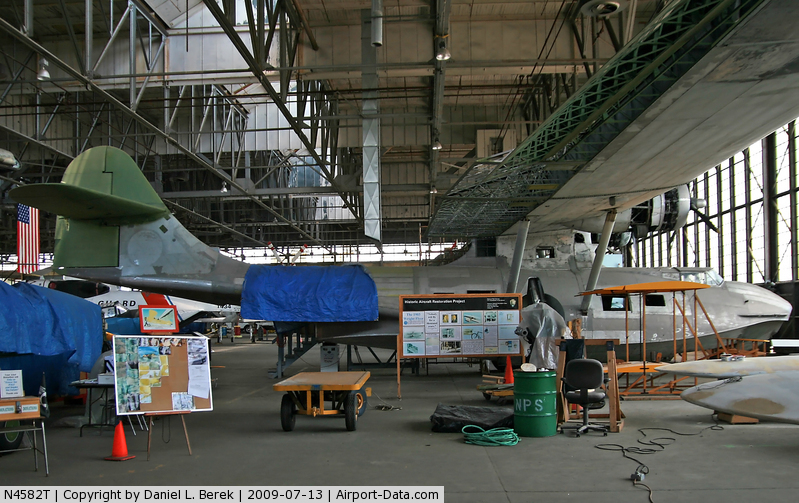
My dad was in love with the idea of flying boats; we’ve seen photos of his small float plane earlier in this blog. In this photo, taken by him in 1958, we see a Catalina PBY flying boat which was then owned by the Brazilian Air Force. It was in the U.S. being converted to a cargo plane; the plane itself was probably built in 1944. I don’t know where this was taken, but it was probably an airfield in Texas (NOTE: Please see Bill Bailey’s comment; this was taken at New Orleans Lakefront Airport in front of the Pan-Air hangar):

These planes are large; the photo doesn’t convey a sense of scale. The lovely blue-and-white plane also shown is a Piaggio P-136-L1 seaplane, and it isn’t small. I’m willing to bet Dad was there trying to buy that smaller plane when he took the photo.

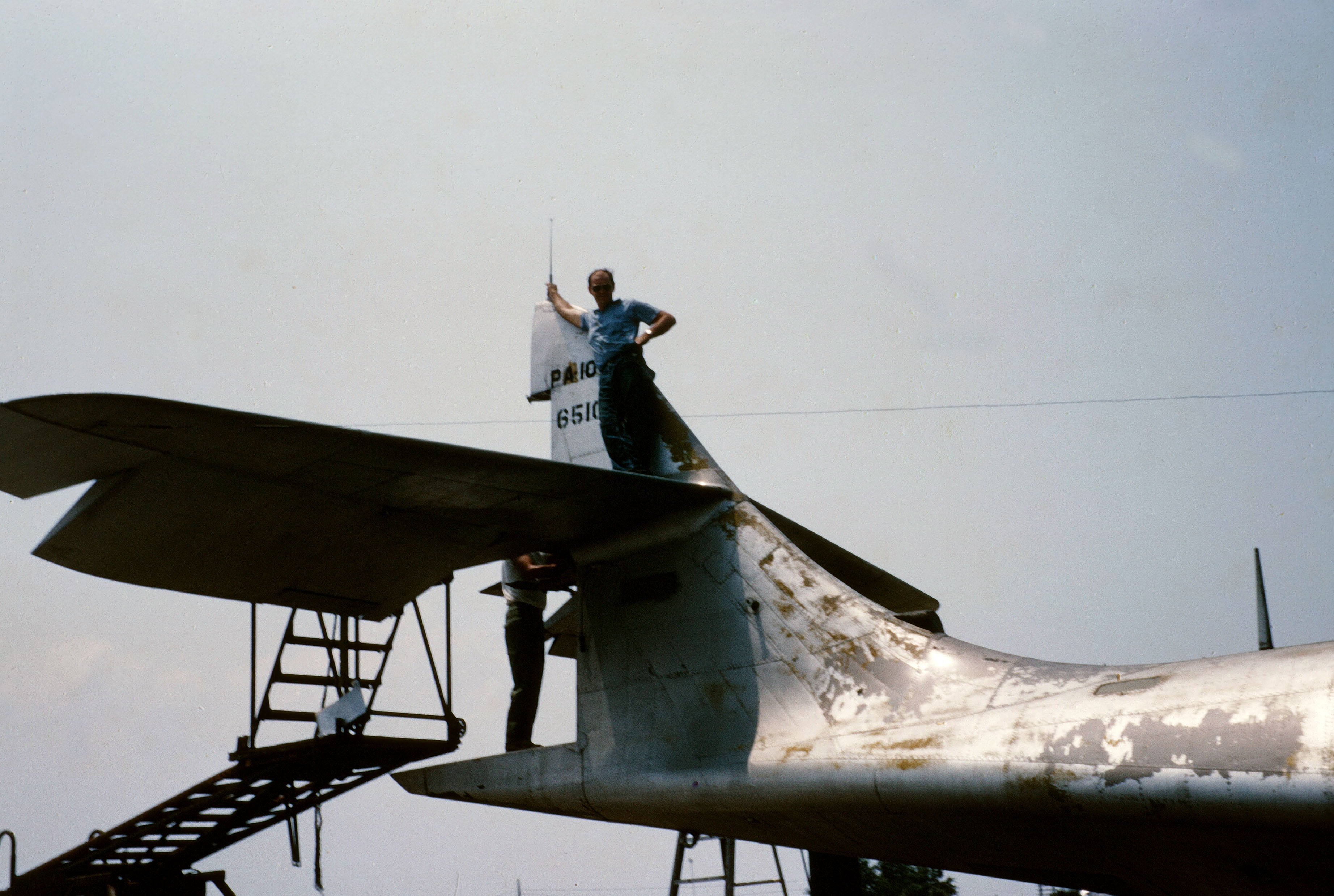
This photo below gives a better idea of the size of a Catalina PBY; these two men are standing on the horizontal and vertical stabilizers of a Catalina; the rudder of the plane is missing:

Dad wanted to own one of these planes in a bad way; the second photo was taken by either my dad or me at an airplane graveyard out West. I was dragged there by my dad on a search for a PBY he could buy, but that’s a story for another day. Today, we’re discussing one particular aircraft.

Here’s what I found on the Net.

This PBY was in air-force service in Brazil until the late 1980s, from what I can find. Here’s the same plane seen in the first photo above, wearing a different paint livery:

Planes can have a very long service life, as we are seeing today! At some point in the last 20 years, this Catalina was purchased by the U.S. Navy and given a new registration. U.S. planes have a reg number with the letter N in front of the numbers; Brazilian aircraft use two letters in front of their registration numbers, but they all start with a P.

In this final photo, we see the same plane recently, being lovingly restored by volunteers at Floyd Bennett Field, in Brooklyn, New York. She’s currently at the National Museum of Naval Aviation, Pensacola, Florida, though she was in Long Beach, California for at least a while. Pretty cool for a plane that’s at least 68 years old. I’ll try to find a photo showing the plane after this restoration.

When Will Their Bubble Burst? Beatles For Sale!

Leave a comment

Folks who weren’t around in the Sixties may find it hard to believe, but The Men In Suits at Capitol Records refused, initially, to release Beatle records in the United States because no pop group from England had ever sold in this country. What made this even more nonsensical was that The Beatles’ UK record label, Parlophone, and the U.S. label, Capitol, were both divisions of the EMI recording giant. Thus, Parlophone was contractually obligated to offer their releases to Capitol first, and Capitol responded, more than once, “No, thanks!” Parlophone would then sell or lease the records to whomever they could find in the U.S. to deal with.

In an earlier post, I mentioned The Beatles’ Ed Sullivan Show appearance in early February, 1964. Both before and after that milestone, members of the press were constantly speculating about how long the Beatles “bubble” would last, and they’d query the band as to what they planned to do for a living once the bubble burst. Ringo famously replied to one such question that he’d like to own a beauty parlor!

So at first, if you wanted to listen to a Beatles record in this country, you had to look hard to find it. I remember the first 45 or single (two-songs, front and back for today’s younger readers) of The Beatles that I bought was She Loves You issued by Swan Records, a small independent label out of Philly.

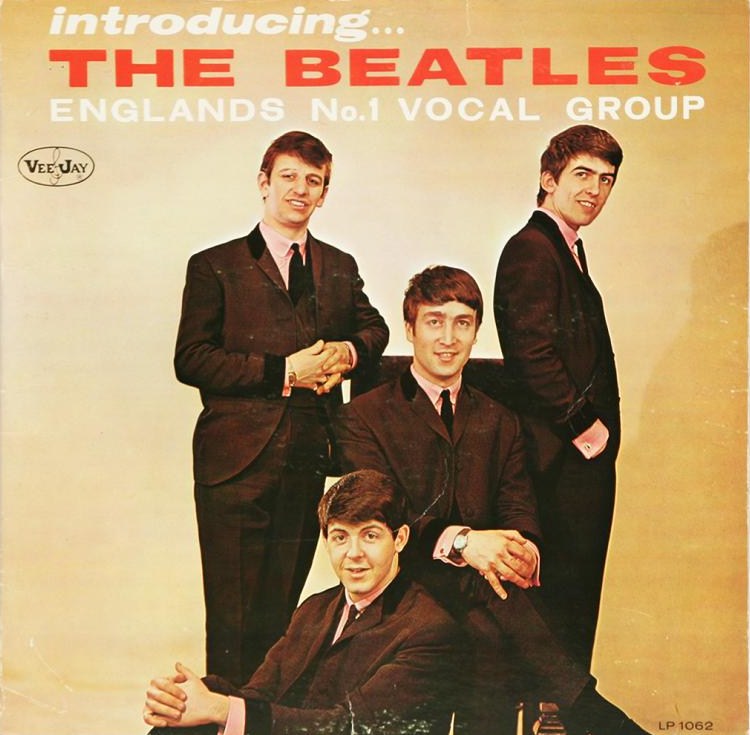
As far as albums, or LPs (long-players) as we called them then, the first release of The Beatles in the U.S. was on the jazz/R&B VeeJay label. It was a version of The Fabs’ first British LP, Please Please Me. Here’s the VeeJay album cover with some very young-looking Beatles; note that Ringo’s hair hadn’t quite settled into the “moptop” style at the time this photo was taken:

After the appearance on Ed Sullivan, Capitol released Meet the Beatles in this country, and it was a chopped-up version of the second UK Beatles release, With the Beatles:

So began a long series of U.S. Capitol record releases that took Beatles UK releases and switched or cut songs, added reverb and generally fiddled around with them.

It wasn’t until Sgt. Pepper that a Beatles LP was the same in both Britain and the U.S., and even after that, there was still some monkeying around with U.S. releases on Capitol Records.

Ladies And Gentlemen . . . The Beatles! And A Theory!

6 Comments

When The Beatles appeared on the Ed Sullivan Show on Sunday night, February 9, 1964, it was a very big deal, at least to the kids in this country. Our family was living in Fernandina Beach, Florida, and for once, I put my foot down and told my mom we had to have a new TV. Our old one had conked out a couple of months before, and I wanted to see and hear The Beatles on TV.


At that point, I was on the fence about whether I liked them or not, but I wasn’t going to miss out on the chance to see them and make up my mind. Amazingly, my mom caved in and bought us a new GE 19″ portable, and, of course, it was a black-and-white set, with the nifty stand as shown in this ad. Television wasn’t usually in color in those days; the first primetime TV season broadcast totally in color wasn’t until 1966.

This was arguably the most important television session The Fabs ever did; it was their first chance to perform in the United States and Ed Sullivan was the (then) most popular show on TV.

Now here is something I think is pretty obvious, but I’ve never seen it written about or discussed elsewhere: I firmly believe John’s mike went out on him during the last song (I Wanna Hold Your Hand). The key to this: Watch George! I can hear the audio change about 11:22 in this clip and after that point, all I hear in the vocal mix is Paul. I also think you can see at about 11:55 George is starting to realize something is amiss. If you don’t want to watch the whole clip, just move the slider at the bottom of the view to the time markers I indicate!

Listen carefully to the vocals beginning at 11:58; that should be a two-part harmony but all you can hear is Paul’s part.

I contend that George realizes at about 12:00 that John’s singing into a dead mike and starts laughing at about 12:05.

No matter; they sounded great and by the end of that show, The Beatles had done what they had set out to do: Become the first British rock-and-roll band to be taken seriously by U.S. kids. As for me, I was convinced The Beatles were something new, different and exciting, and thus began my quest to switch from playing an alto saxophone to an electric guitar.

That theater, on Broadway between West 53rd and West 54th in Manhattan, has a wonderful history. Opened in 1927 as Hammerstein’s Theater, it was converted in 1950 to use for television and was renamed CBS-TV Studio 50. Now it’s called the Ed Sullivan Theater and it’s home to David Letterman’s Late Show.

There Were Giants In Those Days . . .

5 Comments

I mentioned silver dollars in my last post. It occurred to me that younger readers may not be familiar with the old U.S. silver dollar coins, which were big (an inch-and-a-half in diameter) and heavy.

They were the biggest coins the U.S. Treasury ever made and were quite impressive. You didn’t see them in circulation all that often, but kids got them for Christmas and I heard that in Las Vegas, the slot machines were made to handle silver dollars.

They were solid silver, or close to it, for many years and had an impressive ring if you dropped one on a table or floor.

My dad had a friend, an old boat captain, who would come by if I was sick and give me either a silver dollar or a Mexican one-peso coin, which was the same size and was also legal U.S. tender for at least a while, as I recall; I know they were accepted at some stores I shopped at in Texas, valued the same as a U.S. silver dollar.

It’s About TIme!

Leave a comment

Back in the early 1960s, there was a lot of interest in time capsules. Usually these were a big deal and there were World’s Fair time capsules, scientific-society time capsules, and, of course, home-made ones. I buried one, made of a big metal coffee can, in our backyard in 1961. That was the year JFK was inaugurated, and I thought it was the beginning of a brave new world.

Being nine years old at the time, I chose what was important to me for my gift to the people of the future. I remember stuffing a Superman comic book into the can, some toys, and a couple of silver dollars I had saved. It was fun imaging how impressed people of the year 2061 would be when they found it!

Of course, my brother and his troops could have dug it up a week after I buried it for all I knew. But it was something to have fun doing.

Fast-forward to today. Remember the post a couple of weeks ago where I identified the home we lived in 50 years ago? Well, I just sent them a letter telling them about the time capsule. Photos taken in 1961 show them where the thing was buried, and I told them if they found anything at all, they were welcome to it.

Whether or not they’ll find anything, or do more than simply toss the letter in the trash, I can’t say. If nothing else, they may get a kick out of seeing what their home looked like over 50 years ago. But if anything interesting turns up, I’ll share it here!!!

UPDATE:

As of the end of November, three and a half months after I sent the letter to the folks at our old address, the people there haven’t responded.

Sorry, Kid . . .

3 Comments

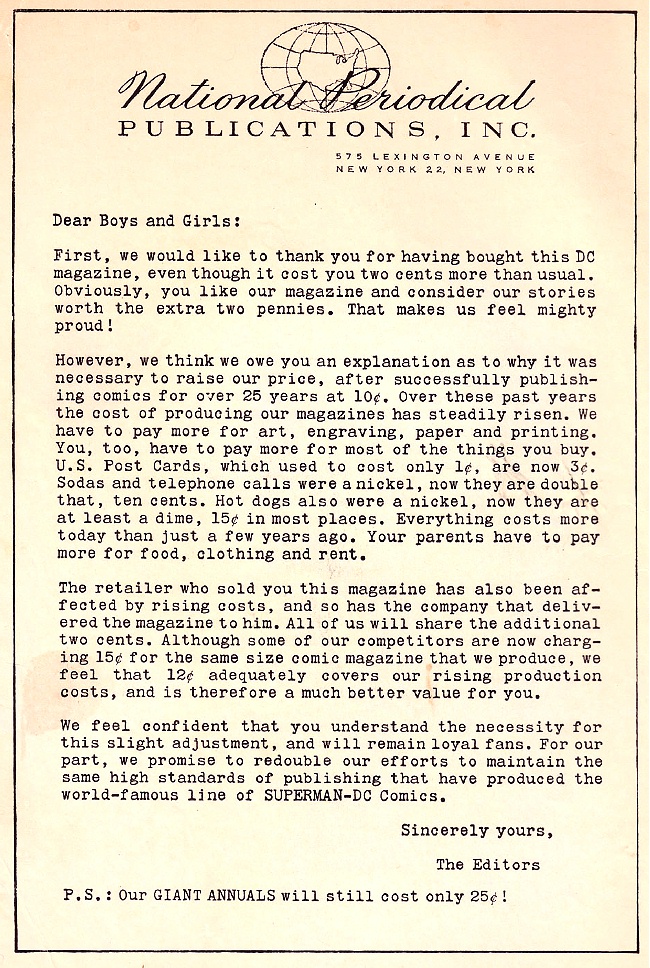
Here’s the announcement DC Comics had on their inside front covers in December, 1961, announcing their 20-percent price increase to twelve cents an issue. I can clearly remember that, though I was only nine years old at the time. Notice the prices of other items DC mentions in this “letter” to the boys and girls who bought the comic:

Of course, the other comic publishers quickly jumped on the bandwagon; Dell Comics, who outsold everyone with their Disney/Warner Brothers-licensed comics and movie/TV-adaptations, went to fifteen cents for a 36-page comic earlier in 1961, at least for a while. From the sales figures I’ve seen, and some folks have published a lot of info on this, sales of comics went into a decided slump after this increase and the slump lasted for a long time. Marvel had just begun their superhero output with the Fantastic Four, but one of their pre-hero monster comics lost 30-percent of its sales.

Today, when a DC or Marvel Comic costs three or four dollars, a couple of pennies doesn’t seem like a big deal, but it was to a kid back then.

For our younger readers, here are some common prices and such from 1961, by way of comparison:

Average cost of new house: $12,500.00
Average income per year: $5,315.00
Cost of a gallon of gas: 27 cents
Average cost of a new car: $2,850.00
23″ black-and-white television: $219.99
Bacon, one pound: 67 cents
Loaf of bread: 20 cents
Eggs, per dozen: 30 cents
Ounce of gold: $35.25

Great Scott!

Leave a comment

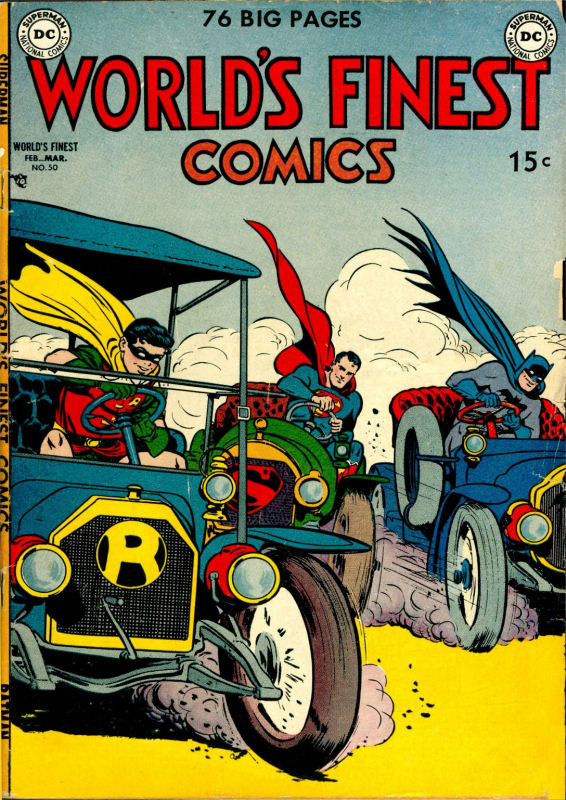
As a kid, I loved comic books and the one I loved the most was DC’s World’s Finest Comics. It had originally started as New York World’s Fair Comics, in 1939. Then it became World’s Best Comics and finally World’s Finest Comics. Its early issues were 96-pagers, but soon settled in at 76 pages for fifteen cents for many years. Superman and Batman each had their own stories, along with a bunch of lesser characters.

The covers showed Superman and Batman together in a poster setting that had nothing to do with the contents of the books. All this was way before my time. The page count began slimming down by the late 1940s, as seen here, but the price stayed at fifteen cents. I have to wonder how many of these comics were sold at a dime, since that was the going rate for a comic book.

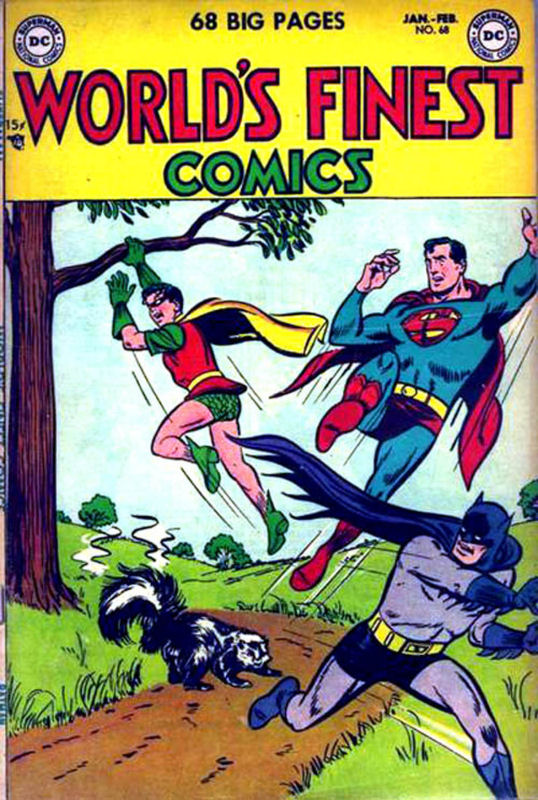
In 1954, when things got tough for comics publishers, DC changed the format to 36 pages (including the covers), cut a lot of the secondary features and reduced the price to ten cents, like most all other comics. They also combined Superman and Batman into one story, which seems an obvious move after all those previous covers showing them both together. Those are the comics I loved; they gave great value for your dime. The art was crisp and well-drawn; the stories were interesting with intriguing plots. And the idea of superheroes being friends was wonderful to a kid.

The Justice League of America, which came out a few years later, had most all the DC heroes, including Superman and Batman, but the art was lame and the stories confusing with seven or eight heroes bouncing around. World’s Finest was more to my liking. Now, too, the covers related to the stories found in the issue.

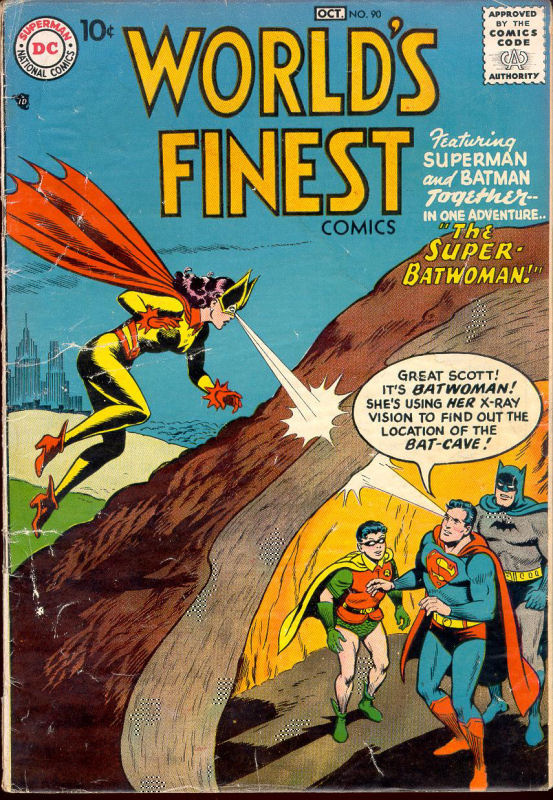
For about 50 issues, World’s Finest Comics were a real hoot, and there were two things about the covers I really liked. Usually, someone (Superman, Batman or Robin) would exclaim, “Great Scott!” at whatever was going on.

And Robin, being rather a fifth wheel, would often be stuck in the bottom corner of the cover.

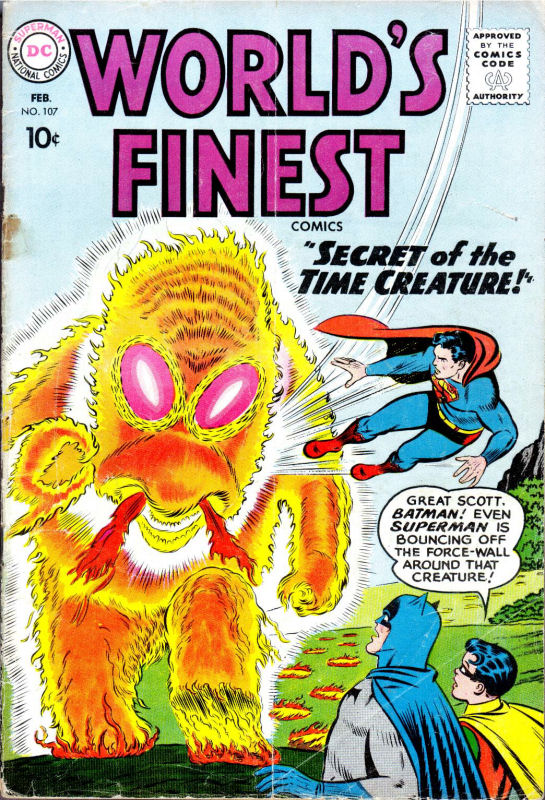
My favorite covers had both the Great Scott! AND Robin in the corner.

I don’t believe I’ve ever heard a real person say, “Great Scott!” but comic books were aimed at 12-year-olds, and the publishers had to be careful. The very early Superman used a lot of “What the–“ exclamations, and the reader could fill in the blank but that only lasted a couple of years. Thus, “Great Scott!” And see that “Still 10¢” in bold type on the pink cover? That was a hint that something was in the works at DC, and it wasn’t good.

After a while, someone at DC must have issued an order about these recurring items, and Great Scott! was replaced with a couple of Great Kryptons! or Great Guns! and once even with a Great Gosh! Robin, instead of being stuck in the corner, was just left off the cover entirely as often as not.

By then the comics had gone up in price to twelve cents each (that previously noted “Still 10¢” really meant “Not Yet 12¢”) and the art wasn’t as lively or well-drawn as it had once been. It was the end of an era.

Grand Day!

Leave a comment

Here are some wonderful photos Patty took today at the Columbia Mall when she met Neenie and the girls for lunch.

Maddie (with Neenie) on the carousel:

Neenie and Maddie on the carousel:

Sophie:

Sophie makes a funny face:

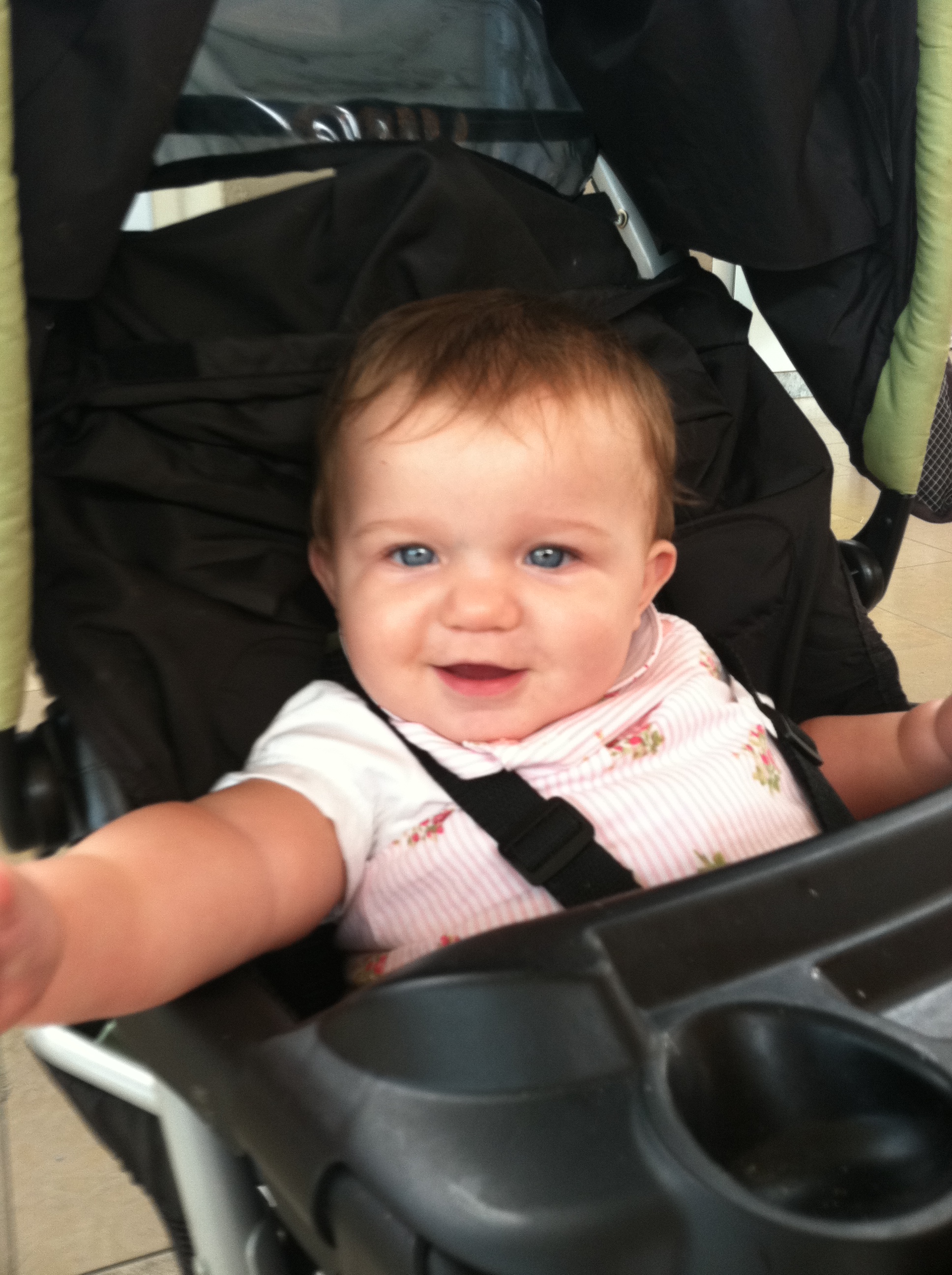
And, for our last picture, Sophie smiles:

Thanks for the photos, Patty!

Auto Repair Excitement: The Final Chapter?

Leave a comment

Patty’s Bug is back in her hands and she’s bravely driving up to Westminster to meet Neenie and the girls for lunch. The car seems, to Patty, to be back to normal.

Next on the agenda for the Bug will be new tires. The old tires have plenty of tread left, but there are cracks in the sidewalls that look suspicious to me. I know that modern tires can’t have “dry rot” like tires in the old days, but it looks rather like that and I don’t want to take any chances.

Older Entries Newer Entries